1.12.2011

Lady Chatterley's Lover by D.H. Lawrence


Lady Chatterley's Lover has been a banned book since it's publication in 1928. Even then it was only published privately in Italy. It wasn't until 1960, after Penguin was acquitted from The Obscene Publications Act of 1959, that the book was published in the UK. After this scandal the book became widely popular. Purchasers eagerly paged through the novel in search of the dirty bits, as shown below:

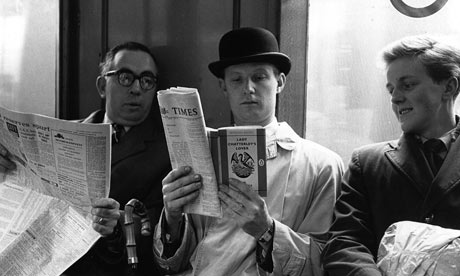

The publication history of this novel is almost as interesting as the novel itself. Not only does Lady Chatterley's Lover examine the love between and man and a woman and the bond it creates - with a focus on the woman's perspective as it relates to her sexual experience; how she perceives good sex verses bad sex, and what it is she yearns for - but it also touches on the cultural implications of industrialization and modernization; namely acting as a threat to modern aestheticism, taking away from the human condition and lending itself to greed - an idea that seems particularly relevant today.

But back to the sex. There were certainly raunchy bits, but they weren't written of colloquially. In fact the dirty parts were written in such a formal tone that is actually made it comical, as sex is usually anything but formal.
Whilst all her womb was open and soft, and softly clamoring, like a sea-anemone under the tide, clamoring fr him to come in again and make a fulfillment for her. She clung to him unconscious in passion, and he never quite slipped from her, and she felt the soft bud of him within her stirring, and strange rhythms flushing up into her with a strange rhythmic growing motion, swelling and swelling til it filled all her cleaving consciousness.
But maybe Lawrence did this intentionally to suggest Lady Chatterley understood these acts of passion to be admirable and dignified as a way of justifying her affair. As Lady Chatterley's lover tells her, "You love fucking alright: but you want it to be called something grand and mysterious, just to flatter your own self-importance."

D. H. Lawrence also has a knack for relating the real and honest aspects that come along with sharing your nakedness with another person. Not only does he communicate the romantic aspect of this excitement, he also highlights the silliness of it; the touching and the exploring of an anatomy that is opposite to ours. I especially laughed when Connie (Lady Constance Chatterley) commented on the "mystery" of a certain part of male anatomy - a sentiment that I happen to share with her:
And the strange weight of the balls between his legs! What a mystery! What a strange heavy weight of mystery, that could lie soft and heavy in one's hand! The roots, root of all that is lovely, the primeval root of all full beauty.
But in all seriousness, I enjoyed Lady Chatterley's Lover very much. It's more than a book with a lot of sex in it. It's a book that explores the significance of the physicality in a relationship - the sexual bond between a man and a woman. Lady's Chatterley's husband, Clifford, and her lover, Mellors, function as foils to one another to highlight the importance of this bond in sustaining a healthy and happy relationship. It's also a sort of "Awakening" tale; the disillusioned woman who is stuck in a loveless relationship finds a new beginning and her true self when she ventures outside of that relationship and explores a new one. According to 1001 Books You Must Read Before You Die, this novel "remains one of the few novels in English literary history that addresses female sexual desire". Well, even though it was written by a man, D. H. Lawrence was spot on.

I should also mention this novel takes a bit of patience to read. It is wonderfully written but things unfold rather slowly and there are lengthy sections of dialogue that discuss the (then) current state of culture and gender roles. While this made the book all the more interesting, it also made it slow going. But I promise your patience will pay off. Lady Chatterley's Lover is well worth the read. I'm even hoping to add more D.H. Lawrence to my nightstand.

Publisher: Barnes and Noble Classics, 1928

1.11.2011

Bookish Resolutions


I don't have too many bad book-reading habits; I never dog-ear my pages (the horror!) and would never annotate the pages with anything but a pencil. But I do have a few bad book
ish habits that I resolve to break.

1. Don't let my TBR pile grow to more than 30 books: I've got a serious book buying habit. It's not out of control, but I love to go shopping for books. This year, I am going to try and keep my TBR pile at bay - therefore only buying books as fast as I can read them.

2. Read and review at least one book a week: I ended 2010 with 52 books read. I'm going to try and match that this year, if not surpass it.

3. Borrow more books: I"m kind of a book hoarder. I only borrow books to a select few people who I know will return them in good condition. However I rarely reread books, so I should be borrowing more books. If I don't see them again, it's not the end of the world.

4. Read more classics: I'm usually pretty good about mixing in the classics to my reading. However the ladder half of 2010 I found myself on a contemporary kick. I'd like to keep around one to every 5 books I read a classic.

5. Read for quality not quantity: I'm easily intimated by fat books. The chunksters. Anything over 600 pages seems like a serious commitment. I need to get over this and start attacking larger books.

6. Take a step back: Sometimes it's easy to get wrapped up in blogging about books and how quickly I can finish them. Every once in a while I need to remind myself to take a step back and remember why I enjoy reading so much in the first place.

7. Read more worldly authors: I read a whole lot of American authors, followed closing by UK authors. I need to expand my reading horizons. I'm especially hoping to get into the Russians.

8. Read more non-fiction: I love my fiction. I could read only fiction everyday for the rest of my life and be happy. But it's good to mix in non-fiction, especially subjects I don't know much about.

Thanks to The Broke and The Bookish for hosting Top Ten Tuesday. I didn't make it to ten this week, but I still think eight resolutions is quite ambitious. Image via weheartit.

1.09.2011

The Bridge of San Luis Rey by Thorton Wilder

Thornton Wilder is the only author to have ever won a Pulitzer Prize in both fiction and drama. The Bride of San Luis Rey is one of his works that earned him a Pulitzer in 1928. The premise of this philosophical novel is straightforward; a footbridge in Peru breaks and takes five people down with it. A monk who witnessed the tragedy asks himself why those five people and begins to uncover the lives of each of the deceased in hopes of revealing if the catastrophe was an act of fate or a coincidence. In other words, The Bridge of San Luis Rey seeks to answer why some people live and others die? Is there a meaning in lives that an individual has no control over?

Wilder conveys a simple yet powerful theme throughout the novel, namely that the act of love is the bridge that joins life and death and this act completes those lives in death. While these ideas make the book a worthwhile read, the getting there was tedious. The novel starts out quite slow and Wilder's prose felt stiff and dense. The second half of the novel picked up after I began to understand where Wilder was going and the connective thread he was creating to link these five characters to one another.
But soon we shall all die and all memory of those five will have left the earth, and we ourselves should be loved for awhile and then forgotten. But the love will have been enough; all those impulses of love return to the love that made them.
As far as classics go, this is a great one, but it doesn't make my top ten. There seemed to be something missing. I can appreciate the deepness of emotion this novel conveys, which is probably what gained it's merit and popularity, but aside from that there isn't much to gush about.

Publisher: Harper Perennial, 1927

1.07.2011

Water for Elephants Trailer

I read this book back in July and really enjoyed it. I've been eagerly waiting the trailer for the movie adaption and it's finally here! The movie is released April 2011. I'm looking forward to seeing Robert Pattinson in a role in which he will have skin color.

Classics Challenge Breakdown


Back in November I signed up for the Classics Challenge. It started January 1st and I've recently finished compiling the list of books I will read for it.

1. A banned book: Lady Chatterly's Lover (D.H. Lawrence) This book has always intrigued me because of the scandal behind it. First published in Italy in 1928, it wasn't allowed to be published in the UK until 1960. Apparently it's pretty racy.

2. A book with a wartime setting: Slaughterhouse Five (Kurt Vonnegut) I'm a huge fan of Vonnegut but believe it or not have never read this one.

3. A Pulitzer Prize (fiction) winner or runner up: The Old Man and the Sea (Earnest Hemingway) I have only read The Sun Also Rises. The Old Man and the Sea won the Pulitzer and was the last major work Hemingway published.

4. A Children's/Young Adult Classic:
Little Women (Louisa May Alcott)
I can't believe I never got around to reading this when I was younger. I guess I was too caught up in The Babysitter's Club series and everything Roald Dahl ever published. I'm really excited for this one.

5. 19th century classic:
The Age of Innocence (Edith Wharton)
I read Ethan Frome a few months back and loved it.

6. 20th century classic: The Bridge of San Luis Rey (Thorton Wilder - reading now) I'm obsessed with trivial pursuit. It's my favorite game ever. The Bridge of San Luis Rey makes a few appearances in the arts and literature category, and that is the main reason I am reading this book.

7. A book you think should be considered a 21st century classic: Middlesex (Jeffrey Eugenides) I've heard fabulous things about this Pulitzer Prize winner and already own a copy.

8. Re-read a book from your high school/college classes: The Awakening (Kate Chopin) I loved this book in high school but don't remember much of it, which calls for a reread.

There it is. So exciting!

1.06.2011

What I Meant Was...

tumblr_lcei6pPkzO1qe099so1_500_large.jpg?1290622822

I laughed and said, "Life is easy." What I meant was, life is easy with you here, and when you leave, it will be hard again. - Miranda July

The Painted Veil by W. Somerset Maugham


I picked this book up after I saw it named a top read of 2010 on a few different blogs. I was certainly not disappointed. Not only was a not disappointed, I absolutely adored this novel. This is one of those treasures that I'm not sure I would have come across if I weren't part of this lovely little book blogging community. Anyhow, this book follows Kitty Fane, a young women who has knowingly married the wrong man out of fear of never marrying. As a bacteriologist, she finds him boring and acts indifferent to his affection. Upon their marriage they move to Hong Kong where he takes up work. After she is caught in an affair a few years later, her husband forces her to accompany him to Mei-tan-fu, the heart of a cholera epidemic. He will go to study the disease in hopes of a cure, and she will accompany him. Of course Kitty feigns poor me, this is no place for a woman. What is she to do in Mei-tan-fu?

But here is what makes this book so great - it's really about two different women; Kitty Fane the woman who can't get enough of herself and the small world she lives in and Kitty Fane the woman who understands there is a bigger picture than what she first thought - one that offers her room to grow into a better person. Of course none of us can completely change for the better; there will always be some fragment of vanity and frivolity, no matter how fleeting, in all of us. But we can do our best to perpetuate positive, meaningful actions in our future, and I think this is what The Painted Veil is about.

Though Kitty allowed no shadow to show on her face, in her heart she laughed. Much she cared what anyone thought of her now!
Of course this theme sounds trite but I promise you, this book is anything but. Maugham's writing is truly lovely and his ability to convey ideas without hitting the reader over the head with them is refreshing. This is a book about the human ability to grow and change for the better. It reminds us that there is more to our lives than what we experience on an average day and there is more to the world than the small part in which we live. It highlights the power of beauty and freedom and the importance death places on life.

I think The Painted Veil would be a fantastic choice for a book club, as there is much to discuss. Not to mention the movie adaption that was made in 2006, which I'm off to hunt down immediately.

Publisher: Vintage, 1925


1.04.2011

Books for Christmas!

I know I am about two weeks overdue on this post, but we all know how busy this time of the year can be - family commitments, vacations, shopping - all that good stuff. Anyhow, I got two fabulous books that I had on my Christmas list from my lovely sister: 1001 Books to Read Before You Die and Audry Niffenegger's The Midnight Book Mobile. Both are new, which is exciting for me since I buy almost all of my books used.


I'm super excited about 1001 books because it's basically a Bible of books. Each of the books featured on the list are included in this book, as well as interesting photos and critical insight.


Each title is listed in chronological order, from earliest publication year to the latest. I was also lucky enough to get the revised and updated 2010 edition.


I couldn't be more pleased. I'm sure I will discover many wonderful new authors this year.