Showing posts with label classics. Show all posts

11.06.2012

The Big Sleep by Raymond Chandler


"You were dead, you were sleeping the big sleep, you were not bothered by things like that, oil and water were the same as wind and air to you. You just slept the big sleep, not caring about the nastiness of how you died or where you fell."

Raymond Chandler is considered to be one of the founders of the "hard-boiled" genre, setting the stage for several generations of crime writers. This book was fun to read and knowing that it was one of the first of its kind, it's even more impressive. The novel has been adapted into film twice (1946, 1978) with the first staring Humphrey Bogart and Lauren Bacall - so you know it was a pretty big deal. Bogart of course plays Philip Marlowe, one of the more memorable characters I've read in while. He lives in a corrupt world that driven him to become cynical; he's hard-drinking lady killer who also happens to be a private detective. Chandler himself admitted to the unbelievability of Marlowe's character when he wrote, “The private detective of fiction is a fantastic creation who acts and speaks like a real man. He can be completely realistic in every sense but one, that one sense being that in life as we know it such a man would not be a private detective.”

I do not think this unbelievability took away from the novel as whole. In fact, it is this lead character and the overall atmosphere of the novel that carries it. The atmosphere is gorgeous and descriptive and everything has that old Hollywood vibe. Although the novel takes place in LA, the setting is less concerned with the city as it is with its immediate surroundings; lavish mansions overlooking the Hollywood hills, clubs that look swanky by night and seedy by day, and of course Marlowe's own dingy office. Added bonus:
I did not predict the ending before it was revealed, which made it even more fun.
 
I will say that I had to pay careful attention to the plot throughout, as it changes often, taking more turns than any other 250 page novel I've read. If I lost concentration for even a page I had to go back and reread it, because you better believe something happened to change the direction of the storyline. Aside from the somewhat confusing plot, I have no complaints. Among his other novels, Chandler wrote a total of seven Philip Marlowe titles. The Big Sleep was the first, and I definitely plan to read more.

Publisher: Vintage Crime, 1939

2.24.2012

The Postman Always Rings Twice by James Cain


The Postman Always Rings Twice is one of the first American classic crime noir novels. I probably wouldn't have picked this book up as soon as I did if it weren't for the Smooth Criminal challenge. I wouldn't say classic American crime is something I gravitate toward all that often, which is one of the main reasons I joined this challenge - to expand my reading horizons! Even though this was published in 1934, the novel reads like it could have been written within the last decade. Frank, a onetime criminal and longtime drifter, finds himself in a suburb of LA and takes a job at a roadside diner, on account of the Greek owner's knockout of a wife, Cora. (Even though she has dark hair, she's not Mexican you guys.) Frank and Cora are quickly drawn to each other and decide they must get rid of the "greasy" Greek in hopes of living happily ever after. What follows is a series of events that go from bad to worse. 

This book is known for its violence and eroticism, and was even banned in Boston upon its publication. I rather enjoyed the bits of sexual violence Cain included - they weren't over the top (by today's standards, anyway) but proved to be just enough to keep my interest piqued. And the end! Let's just say I was quite satisfied. The novel as a whole examines the animal instincts of man and the amoral nature of human kind.

From the beginning the title of this novel intrigued me and I was eager to find its reference within the text. I thought it may reference some sort of secret code between Frank and Cora, something that would help them to sneak around the Greek in the first half of the novel. To my disappointment, neither a postman nor a man ringing twice appears, or is even alluded to. After a quick google search I discovered there doesn't seem to be a definitive reason for the title. There are speculations that it referenced an actual murder case, but Cain apparently himself noted it came from a conversation he had with a screenwriter friend. 

I'm still not certain what exactly constitutes a book as noir, but having read a few I'm starting to get a better idea. Postman is a slim novel that I enjoyed reading. Overall the book is well-paced, brutal, and altogether thrilling. 

I read this book for the Smooth Criminals challenge, fulfilling a noir classic.

Publisher: Vintage, 1934

1.25.2012

The Western Lit Survival Kit by Sandra Newman


In The Western Lit Survivial Kit, author Sandra Newman seeks to shed a new light on the classics to prove they are less intimidating and more readable than you think. She argues that reading literature should be "emotionally satisfying, intellectually thrilling, and just plain fun." By providing a humorous guide that covers nearly every important work in the Western literary canon, Newman resurrects the classics you forgot you read in college and helps you remember why you studied them in the first place. Starting with classical literature, the Greeks and the Romans, and covering everything through the 20th century, Newman deconstructs the plots of important authors into concise summaries, so even if you never got around to reading Chaucer's Sir Gawain and the Green Knight, at least you've got a basic knowledge of its plot. 

What is great about this book is that it makes for a great refresher if it has been awhile since your undergraduate lit survey classe (as it has been for me). I feel like I have brushed up on many of the movements, their key players and what made each so significant. The book can also work as an introduction to the history of the classics and would certainly make a good supplement to any related courses. I know the chapter on Shakespeare would have helped me greatly in my Shakespearean Drama class, where we read a play a week for 15 weeks. When studying for my final, it was hard for me to keep all the historical plays in order. While this isn't the end all be all book when it comes to western lit, it certainly helps clarify some of the fuzziness. 
This book treats Western lit like an amusement park. It offers a guide to the rides, suggesting which ones are fun for all ages, which are impossibly dull for all ages, and which might take a lot out of you but offer an experience you simply can't get anywhere else.
What I found especially helpful about this book is it's rating system. Newman conveniently rates each work by each author she cites by it's importance, accessibility and fun, making it easy to weed through the lesser important works in favor for the ones that are more worth your while. The book as a whole has motivated to tackle more classics. While their may not be any new information or profound opinions included in this guide, and though it's likely you'll roll your eyes at some of her jokes, Newman's fresh take on the classics is sure to inspire a non-classic reader to take a look at the works that set the precedent for future literature. 

I was provided a copy of this book by TLC Book Tours in exchange for my honest review.

Publisher: Gotham Books, 2012

1.17.2012

Top Ten Books I'd Recommend To Someone Who Doesn't Read Classics


I'm pretty sure most of you who read this blog have read a wide variety of classics, in which case, you don't really need this list. However, if there are some of you out there who typically shy away from classics, this is a list of them that I have read, which I believe to be quite accessible and fun to read. I am loosely using the term "classics" here to signify works that are widely considered worth studying.

1. The Adventures of Huckleberry Finn by Mark Twain: Widely considered the Great American Novel, this is the story of a boy's adventures in the Mississippi Valley.
sample: "But I reckon I got to light out for the territory ahead of the rest, because Aunt Sally she’s going to adopt me and sivilize me, and I can’t stand it. I been there before."

2. Animal Farm by George Orwell: A political allegory that depicts barnyard animals to highlight powerful social commentary. This book, in my opinion, has one of the best closing sentences in the history of closing sentences.
sample: "All animals are equal, but some animals are more equal than others."

3. To Kill a Mockingbird by Harper Lee: The unforgettable novel of a childhood in a sleepy Southern town and the crisis of conscience that rocked it. (From Goodreads.)
sample: "You never really understand a person until you consider things from his point of view... Until you climb inside of his skin and walk around in it."

4. The Mill on the Floss by George Eliot: In my opinion, this is the most accessible Eliot novel. A buldungsroman that follows the rebellious Maggie Tulliover from youth to maturity.
sample: "Her future, she thought, was likely to be worse than her past, for after her years of contented renunciation, she had slipped back into desire and longing; she found joyless days of distasteful occupation harder and harder; she found the image of the intense and varied life she yearned for, and despaired of, becoming more and more importunate."

5. Things Fall Apart by Chinua Achebe: This story examines the consequences of when white Europeans try to colonize an African villiage.
sample: "We have heard stories about white men who made the powerful guns and the strong drinks and took slave away across the seas, but no one thought the stories were true."

6. Native Son by Richard Wright: I finished this over a week ago and I'm still mulling it over. The novel explores what it means to be black in America.
sample: "Violence is a personal necessity for the oppressed...It is not a strategy consciously devised. It is the deep, instinctive expression of a human being denied individuality."

7. The Moonstone by Wilkie Collins: A valuable stone goes missing and a slew of narrators theorize as to who may have done it. Truly a page turner.
sample: "Here follows the substance of what I said, written out entirely for your benefit. Pay attention to it, or you will be all abroad, when we get deeper into the story. Clear your mind of the children, or the dinner, or the new bonnet, or what not. Try if you can't forget politics, horses, prices in the city and grievances at the club. I hope you won't take this freedom on my part amiss; it's only a way I have of appealing to a gentle reader.

8.The Great Gatsby by F. Scott Fitzgerald: Another American classic, examines the possibilities of the American dream, as well as its pitfalls.
sample: "He smiled understandingly-much more than understandingly. It was one of those rare smiles with a quality of eternal reassurance in it, that you may come across four or five times in life. It faced--or seemed to face--the whole external world for an instant, and then concentrated on you with an irresistible prejudice in your favor. It understood you just as far as you wanted to be understood, believed in you as you would like to believe in yourself."

9. A Doll's House - Henrik Ibsen: A moving play that looks at the convention of marriage in the late 1800's.
sample: "I believe that before all else I am a reasonable human being, just as you are--or, at all events, that I must try and become one."

10. White Noise by Don DeLillo: My favorite DeLillo to date, White Noise examines family life in the age of extreme consumerism.
sample: "When I read obituaries I always note the age of the deceased. Automatically I relate this figure to my own age. Four years to go, I think. Nine more years. Two years and I'm dead. The power of numbers is never more evident than when we use them to speculate on the time of our dying."

Top Ten Tuesday is hosted by The Broke and The Bookish.

7.13.2011

Howards End by E.M. Forster


I picked up Howards End shortly after I bought Zadie Smith's On Beauty because Greg from The New Dork Review of Books told me that in order to fully appreciate On Beauty, I should read Howards End first. I've got to be honest, I am a little burnt out on the classics. This book probably wasn't the best choice considering the timing - I just finished the Back to the Classics Challenge at the end of June. I was a little cranky toward this book, mostly because I wanted it to end. But please know, my opinion of this novel is a bit apathetic simply because lately, my reading diet has been overwhelmed with too many classics.

Howards End examines the Edwardian era, when the class system in England was disordered and allowed for social upheaval. Forster reflects on these subjects through two different families: The Wilcoxes and the Schlegels. Forster also highlights a shift of interest in women's suffrage, characterized by the liberal and idealistic Margaret Schlege. Each family, while of the same class, maintain very different values and connect in a way that exposes both their successes and their failures.
Houses have their own ways of dying, falling as variously as the generations of men, some with a tragic roar, some quietly, but to an after-life in the city of ghosts, while from others from others - and thus was the death of the Wickham Place - the spirit slips before the body perishes. It had decayed in the spring, disintergrating the girls more than they knew, and causing either to accost unfamiliar regions. By September it was a corpse, void of emotion, and scarcely hallowed b the memories of thirty years of happiness.
The novel is full of political symbolism and nuanced social views. It examines an array of human emotions and the inevitable conflicts they cause. Howards End really is a work of art and I'm happy to have read it. I just wish I would have read it at a different time. I think this was a case of right book at the wrong time.

Publisher: Barnes and Noble Classics, 1910

6.29.2011

Passing by Nella Larson

"I've often wondered why more coloured girls never 'passed' over. It's such a frightfully easy thing to do. If one's the type, all that's needed is a little nerve."

I reread this one to finish up the Back to the Classics Challenge to fulfill a reread from high school or college. I first read this in my AP English class (I can't remember which year) and didn't remember much about it except that I liked it.

Nella Larson was an author of the Harlem Renaissance. In her second novel, Passing, we meet Irene and her childhood friend Clare. While Irene embraces her African American heritage, Clare, a fair-skinned and elegant black woman, is married to a white man who is unaware of her ethnicity; she is "passing" for a white woman. When the two women meet again years later they each face their black cultural consciousness in very different ways. The consequences of Clare's "passing" proves to be more complex than she first thought and eventually prompts Irene to reconsider her own ideas about race.
She was caught between two allegiances, different, yet the same. Herself. Her race. Race! The thing that bound and suffocated her... Irebe Redfield wished, for the first time in her life, that she had not been born a negro. For the first time she suffered and rebelled because she was unable to disregard the burden of race. It was, she cried silently, enough to suffer as a woman, and individual, on one's own account, without having to suffer for the race as well.
Through the dual figures of Clare and Irene, Passing examines the complexities and intricacies of racial identity in the Harlem Renaissance. It also explores women's sexuality and how it's repression is related to racial repression. Larson conveys the ideas of pretentiousness and the false authenticity associated with Clare's misleading identity to satirize the ambitions of the African-American bourgeoisie in 1920's New York.

One of my favorite things about this novel is that Larson leaves much of the story open-ended. We are not left with a definitive conclusion, and there are many ways of interpreting the underlying issues of the novel. It's a shorter novel, but it packs a punch.

Publisher: Penguin Classics, 1929

6.26.2011

Back to the Classics Challenge Complete!


Hosted by Sarah from Sarah Reads Too Much, the Back to the Classics Challenge began in January and ends June 30th. (Sarah later pushing the end date back to December 31st, but I wanted to try and stick to the original date.)

8 goals to complete:

1. A banned book
Lady Chatterley's Lover by D. H. Lawrence (1928)

2. A book with a wartime setting (any war)
Slaughterhouse-Five by Kurt Vonnegut (1969)

3. A Pulitzer Prize (fiction) winner or runner up
The Old Man and the Sea by Ernest Hemingway (1952)

4. A Children's/Young Adult Classic
Little Women by Louisa May Alcott (1868)

5. 19th century classic
Thérèse Raquin by Émile Zola (1867)

6. 20th century classic
The Bridge of San Luis Rey by Thornton Wilder (1927)

7. A book you think should be considered a 21st century classic
Middlesex by Jeffery Eugenides (2002)

8. Re-read a book from your high school/college classes
Passing by Nella Larson (1929)
*review coming soon

Done, done and done! Cheers to a summer of reading whatever my little heart desires.

image via Booklover

6.22.2011

Little Women by Louisa May Alcott


I never read Little Women when I was a girl. I decided to pick it up for a YA classic of the back to the classics challenge, hosted by Sarah at Sarah Reads Too Much. I was excited to finally get around to reading this much-loved classic. Well, I feel kind of bad about this, because I know this is a favorite among many, but I didn't like it. Usually the faster I read a book, the more I like it. This one took me 20 days, which is quite long for me. Mostly, the book bored me.

Little Women is the classic story of idealized 19th century family life that examines a girl's growth and progress into womanhood. I wish I would have read this as a young girl, because I think I would have been able to relate to it more. Instead, I found it dull. I never felt invested in the story; rather than take an emotional journey with the characters, I felt like I was simply reading about it, disconnected.

Publisher: Barnes and Noble Classics, 1868

4.22.2011

Thérèse Raquin by Émile Zola


I enjoyed Thérèse Raquin much more than I thought I would. This was my first Zola and I was prepared for long, drawn-out prose and perhaps a less-than-exciting, 19th century plot. It was a nice surprise that this book turned out to be wonderfully creepy and suspenseful (save the somewhat slow start). The direct prose read quickly and while the translation didn't give the text much richness, I'm wondering what Zola's unaltered French prose was like. 

My first thought upon completing this book: It would be perfect to read around Halloween, specifically for the RIP challenge. It's a story of twisted, turbulent, tormented love at it's finest. The cover art really speaks toward the content. 
These sudden, alternating sensations of desire and disgust, the successive touch of flesh burning with love and of cold flesh softened by the mud, made him pant and shudder, gasping in horror. 
Thérèse Raquin is a work of naturalist fiction in which Zola uses a detached tone to study the animal-like lovers Thérèse and Laurent after they murder for the sake of their love, only to become painfully haunted by their actions. Thérèse Raquin examines human instinct, dark passion and moral decline and explores the free will of the "human animal". It's both erotic and meticulously detached, and all-in-all, shocking. 

Publisher: Penguin Classics, 1867

3.28.2011

A Room of One's Own by Viriginia Woolf

and I thought how unpleasant it is to be locked out; and I thought how it is worse perhaps to be locked in...

Virginia Woolf died 60 years ago today, which coincidentally fell on the same day of my review of her extended essay A Room of One's Own. The essay explores women and writing; if women were offered the same opportunities as men could they write in equal quality? Were financial limitations the only thing that held them back? And if so, why are men offered more opportunity than women?

Woolf explores these questions and their implications and then goes on to encourage an integrated humanity, one where writers (women and men alike) can write without any hindrances. The title of the work comes from Woolf's assertion that "a woman must have money and a room of her own if she is to write fiction."

Overall I found the book to be a little dry, but full of interesting ideas. If you are interested in women and writing, this text is a must-read. But it's more than that. A Room of One's Own explores the relationship between gender and socioeconomics throughout history and ends on a hopeful note. These essays are based on a series of lectures that Woolf gave to women's colleges at Cambridge University. What a lucky group of students.

Publisher: Harcourt, 1929

3.02.2011

The Age of Innocence: Book Two


The Age of Innocence read-along is hosted by Beth at Bookworm Meets Bookworm. Today we are posting our thoughts on Book Two and the entire novel overall. You can read my thoughts on Book One here.

Oh Edith Wharton - she is truly fantastic. Prior to The Age of Innocence, I had only read Ethan Frome, which I liked very much. Wharton has now established herself to be a master in relating a tortured love story. But it really is much more than that. I think one of the things that makes The Age of Innocence so powerful is Wharton's ability to impose the character's emotions onto the reader. Book One concluded with the announcement that Archer's wedding had been pushed forward. We still weren't sure what would happen with Ellen and I wondered whether or not Archer would go through with the wedding. Book Two opens on Archer's wedding day. Wharton throws her readers into the event - highlighting the haste and slight confusion Archer himself undergoes. Wharton also does this to the reader in the end when we jump forward many years to learn about May's death, the birth of Archer's children and his son's engagement to Fanny Beaufort. There is a disconnection between Archer's life as we left it and the one that we now learn about.
Nothing could more clearly give the measure of the distance that the world had traveled. People nowadays were too busy - busy with reforms and "movements," with fads and fetishes and frivolities - to bother much about their neighbors. And of what account was anybody's past, in the huge kaleidoscope where all the social atoms spun around on the same plane?
In my post on Book One I mentioned that this book is almost a work of observational anthropology, critiquing our inherent societal values and rejection of the unusual. These ideas are true throughout Book Two as well. Wharton further examines Old New York society in Book two by considering its gender relations. In Book One we are lead to believe May falls short of average intelligence, but in Book Two we see her "blue eyes wet with victory" when Archer knows he must stay with her and let Ellen go. I think Wharton is highlighting the underrated astuteness of the girl who plays dumb, and the true potential they hold to get exactly what they want. Wharton also touches on the double standards of an affair and then examines them backward, insisting that a woman is prone to changing her mind and acting impetuously, and it's the man who should be at fault for adulterous actions. I found Wharton's examination of gender relations in Book Two both interesting and witty.

When reading books I am usually hesitant to believe two characters in a novel are truly in love. The author really has to show me this emotion and make it unique - in The Age of Innocence, I never doubted Archer's love for Ellen. Wharton really pulled at my heart strings when Archer picks up Ellen at the train station and states,
Do you know - I hardly remembered you?
Hardly remembered me?
I mean: how shall I explain? I - it's always so. Each time you happen to me all over again.
Now, a discussion of the ending (spoiler alert). I think Wharton really does this entire novel justice when Archer walks away from Ellen without even saying hello years later. I don't think this novel was ever just a love story, which is what it would have been had Archer and Ellen ended up together. I think this is a story about a life of regret. I think this is a novel that articulates the importance of timing in life and the mutability of of our everyday world. It's about doing what's best for those you care about and stifling selfish motivations. It highlights the repercussions of the choices we make and the inability to go back and do things differently. I think it's about understanding societal constraints and despite a yearning for something more, facing the inability to break free of those constraints. All in all, the ending as it was made me think about the book as a whole more than I would have had Ellen and Archer lived happily ever after. Well played, Edith Wharton. Well played.

The Age of Innocence won the 1921 Pulitzer Prize in fiction.

Publisher: Macmillan, 1920

2.16.2011

The Age of Innocence: Book One


The Age of Innocence Read-along is hosted by Beth at Bookworm Meets Bookworm. Today we are posting our thoughts on Book One.

The Age of Innocence earned Edith Wharton the Pulitzer Prize in 1921. Set in "Old New York," we meet Newland Archer, who represents the ultimate figure in New York society. He is recently engaged to May Welland, a marriage that will unite two of New York's oldest families. Enter Countess Ellen Olenska, May's unconventional cousin who has just returned from Europe after a failed marriage.

From the beginning of the novel Wharton evokes the feeling of high-society New York through imagery and language. The opening scene takes us to an opera, an event attended by good society; a place where one can be seen in high fashion, displaying astute manners - while also keeping a close eye on their company, keeping up with the latest social news and gossiping about others when prompted. The opera has the benefit of being "small and inconvenient," thus keeping out the "new people whom New York was beginning to dread and yet be drawn to".

Countess Olenska is one of these characters who is dreaded. She and her cousin May could not be more different. While May is eager to please with her understanding of New York society and it's social expectations, Countess Olenska is more vivacious, understanding New York to be a place where one is taken on vacation "when one has been a good little girl and done all one's lessons". Of course the passionate and unusual (if not sometimes offensive) qualities of Olenska begin to enamor Archer, intriguing him more so than his traditional and meek fiance. Soon he beings to question his engagement.
He saw his marriage becoming what most other marriages about him were: a dull association of material and social interests held together by ignorance on the one side and hypocrisy on the other.
The idea of freedom from society is a prevalent theme in book one. Early on, when defending the Countess, Archer states, "Woman ought to be free - as free as [men] are". He then goes on to feel increasingly oppressed - oppressed by societal expectations and its ridged, unimaginative mores.
And he felt himself oppressed by this creation of factitious purity, so cunningly manufactured by a conspiracy of mothers and aunts and grandmothers and long-dead ancestresses, because it was supposed to be what he wanted, what he had a right to, in order that he might exercise his lordly pleasure in smashing it like an image made of snow.
It isn't until Archer is able to free himself from the city and it's social constrains that he allows himself to fully admit his feeling toward Olenska. It's not suprising that Olenska mimics these this feeling of constraint and yearning toward freedom. After returning to New York her Grandmother wanted Olenska to live with her, to which Olenska explains she had to live on her own - she "had to be free".

Thoughts:

So far I am really enjoying this novel - more so than I thought I would. It's almost a work of observational anthropology, critiquing our inherent societal values and rejection of the unusual. It's like society itself is a main character, because it's that prevalent throughout book one. It has a constant weight and pull on each character and their actions.

Of course I am hoping Archer ends of up the Countess in the end, but he's dug himself into somewhat of a hole. After he convinces the Countess not to divorce and sue her husband (a case in which he would have headed), he realizes he is in love with her, but isn't able to marry her as long as she listens to his advice and doesn't divorce.

Also, I like the bits that describe Archer as an avid reader - getting excited about a new box of books and preferring the "prospect of a quite Sunday at home with his spoils". Later, when he can't get his mind of the Countess after his return from Highbank, he tries to read and while he "turned the pages with the sensuous joy of a book-lover, he did not know what he was reading". I think this is a feeling that all readers can relate, and I enjoy these "bookish" descriptions Wharton includes.

I've also got to say that of May and the Countess - I really relate to the Countess. I'm quite outgoing - sometimes, but rarely, to the point of obnoxious - but have never regretted this quality of mine. I think it's better to be oneself than try to squeeze into a mold that doesn't quite fit. Some of my all-time favorite literary characters have been carefree women who forge their own path regardless of what people think and Countess Olenska is certainly one of these characters. I don't think that she doesn't recognize her "misbehavior" in the sense that it goes against scoietal norms - I think it's that she doesn't care. She would rather stay true to herself and seek freedom from these constrains.

I'm really looking forward to book two. I'm hoping Archer can man-up!

2.01.2011

Penguin: 10 Essential Classics Redux


Last year Penguin compiled their 10 Essential Penguin Classics, a list of book they believed everyone should read. After announcing the list they received a lot of push back from disgruntled readers who complained the list wasn't accurate. So Penguin asked it's readers to vote and today they announced the 10 Essential Penguin Classics Redux. On the list:

1. Pride and Prejudice - Austen
2. Hamlet - Shakespeare
3. The Adventures of Huckleberry Finn - Twain
4. The Odyssey - Homer
5. Jane Eyre - Bronte
6. Romeo and Juliet - Shakespeare
7. Great Expectations - Dickens
8. Little Women - Alcott
9. Wuthering Heights - Bronte
10. The Canterbury Tales - Chaucer

So what was bumped off the list? Of Mice and Men, Moby Dick, Metamorphosis, Oedipus Rex, Walden and The Inferno. Me? I prefer the redux. I'm especially happy to see The Canterbury Tales make the list, as that was the title I voted for. However I am sad to see Of Mice and Men and Oedipus Rex go.

1.12.2011

Lady Chatterley's Lover by D.H. Lawrence


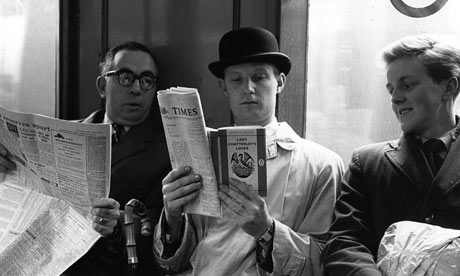
Lady Chatterley's Lover has been a banned book since it's publication in 1928. Even then it was only published privately in Italy. It wasn't until 1960, after Penguin was acquitted from The Obscene Publications Act of 1959, that the book was published in the UK. After this scandal the book became widely popular. Purchasers eagerly paged through the novel in search of the dirty bits, as shown below:


The publication history of this novel is almost as interesting as the novel itself. Not only does Lady Chatterley's Lover examine the love between and man and a woman and the bond it creates - with a focus on the woman's perspective as it relates to her sexual experience; how she perceives good sex verses bad sex, and what it is she yearns for - but it also touches on the cultural implications of industrialization and modernization; namely acting as a threat to modern aestheticism, taking away from the human condition and lending itself to greed - an idea that seems particularly relevant today.

But back to the sex. There were certainly raunchy bits, but they weren't written of colloquially. In fact the dirty parts were written in such a formal tone that is actually made it comical, as sex is usually anything but formal.
Whilst all her womb was open and soft, and softly clamoring, like a sea-anemone under the tide, clamoring fr him to come in again and make a fulfillment for her. She clung to him unconscious in passion, and he never quite slipped from her, and she felt the soft bud of him within her stirring, and strange rhythms flushing up into her with a strange rhythmic growing motion, swelling and swelling til it filled all her cleaving consciousness.
But maybe Lawrence did this intentionally to suggest Lady Chatterley understood these acts of passion to be admirable and dignified as a way of justifying her affair. As Lady Chatterley's lover tells her, "You love fucking alright: but you want it to be called something grand and mysterious, just to flatter your own self-importance."

D. H. Lawrence also has a knack for relating the real and honest aspects that come along with sharing your nakedness with another person. Not only does he communicate the romantic aspect of this excitement, he also highlights the silliness of it; the touching and the exploring of an anatomy that is opposite to ours. I especially laughed when Connie (Lady Constance Chatterley) commented on the "mystery" of a certain part of male anatomy - a sentiment that I happen to share with her:
And the strange weight of the balls between his legs! What a mystery! What a strange heavy weight of mystery, that could lie soft and heavy in one's hand! The roots, root of all that is lovely, the primeval root of all full beauty.
But in all seriousness, I enjoyed Lady Chatterley's Lover very much. It's more than a book with a lot of sex in it. It's a book that explores the significance of the physicality in a relationship - the sexual bond between a man and a woman. Lady's Chatterley's husband, Clifford, and her lover, Mellors, function as foils to one another to highlight the importance of this bond in sustaining a healthy and happy relationship. It's also a sort of "Awakening" tale; the disillusioned woman who is stuck in a loveless relationship finds a new beginning and her true self when she ventures outside of that relationship and explores a new one. According to 1001 Books You Must Read Before You Die, this novel "remains one of the few novels in English literary history that addresses female sexual desire". Well, even though it was written by a man, D. H. Lawrence was spot on.

I should also mention this novel takes a bit of patience to read. It is wonderfully written but things unfold rather slowly and there are lengthy sections of dialogue that discuss the (then) current state of culture and gender roles. While this made the book all the more interesting, it also made it slow going. But I promise your patience will pay off. Lady Chatterley's Lover is well worth the read. I'm even hoping to add more D.H. Lawrence to my nightstand.

Publisher: Barnes and Noble Classics, 1928

1.09.2011

The Bridge of San Luis Rey by Thorton Wilder

Thornton Wilder is the only author to have ever won a Pulitzer Prize in both fiction and drama. The Bride of San Luis Rey is one of his works that earned him a Pulitzer in 1928. The premise of this philosophical novel is straightforward; a footbridge in Peru breaks and takes five people down with it. A monk who witnessed the tragedy asks himself why those five people and begins to uncover the lives of each of the deceased in hopes of revealing if the catastrophe was an act of fate or a coincidence. In other words, The Bridge of San Luis Rey seeks to answer why some people live and others die? Is there a meaning in lives that an individual has no control over?

Wilder conveys a simple yet powerful theme throughout the novel, namely that the act of love is the bridge that joins life and death and this act completes those lives in death. While these ideas make the book a worthwhile read, the getting there was tedious. The novel starts out quite slow and Wilder's prose felt stiff and dense. The second half of the novel picked up after I began to understand where Wilder was going and the connective thread he was creating to link these five characters to one another.
But soon we shall all die and all memory of those five will have left the earth, and we ourselves should be loved for awhile and then forgotten. But the love will have been enough; all those impulses of love return to the love that made them.
As far as classics go, this is a great one, but it doesn't make my top ten. There seemed to be something missing. I can appreciate the deepness of emotion this novel conveys, which is probably what gained it's merit and popularity, but aside from that there isn't much to gush about.

Publisher: Harper Perennial, 1927

1.07.2011

Classics Challenge Breakdown


Back in November I signed up for the Classics Challenge. It started January 1st and I've recently finished compiling the list of books I will read for it.

1. A banned book: Lady Chatterly's Lover (D.H. Lawrence) This book has always intrigued me because of the scandal behind it. First published in Italy in 1928, it wasn't allowed to be published in the UK until 1960. Apparently it's pretty racy.

2. A book with a wartime setting: Slaughterhouse Five (Kurt Vonnegut) I'm a huge fan of Vonnegut but believe it or not have never read this one.

3. A Pulitzer Prize (fiction) winner or runner up: The Old Man and the Sea (Earnest Hemingway) I have only read The Sun Also Rises. The Old Man and the Sea won the Pulitzer and was the last major work Hemingway published.

4. A Children's/Young Adult Classic:
Little Women (Louisa May Alcott)
I can't believe I never got around to reading this when I was younger. I guess I was too caught up in The Babysitter's Club series and everything Roald Dahl ever published. I'm really excited for this one.

5. 19th century classic:
The Age of Innocence (Edith Wharton)
I read Ethan Frome a few months back and loved it.

6. 20th century classic: The Bridge of San Luis Rey (Thorton Wilder - reading now) I'm obsessed with trivial pursuit. It's my favorite game ever. The Bridge of San Luis Rey makes a few appearances in the arts and literature category, and that is the main reason I am reading this book.

7. A book you think should be considered a 21st century classic: Middlesex (Jeffrey Eugenides) I've heard fabulous things about this Pulitzer Prize winner and already own a copy.

8. Re-read a book from your high school/college classes: The Awakening (Kate Chopin) I loved this book in high school but don't remember much of it, which calls for a reread.

There it is. So exciting!

1.06.2011

The Painted Veil by W. Somerset Maugham


I picked this book up after I saw it named a top read of 2010 on a few different blogs. I was certainly not disappointed. Not only was a not disappointed, I absolutely adored this novel. This is one of those treasures that I'm not sure I would have come across if I weren't part of this lovely little book blogging community. Anyhow, this book follows Kitty Fane, a young women who has knowingly married the wrong man out of fear of never marrying. As a bacteriologist, she finds him boring and acts indifferent to his affection. Upon their marriage they move to Hong Kong where he takes up work. After she is caught in an affair a few years later, her husband forces her to accompany him to Mei-tan-fu, the heart of a cholera epidemic. He will go to study the disease in hopes of a cure, and she will accompany him. Of course Kitty feigns poor me, this is no place for a woman. What is she to do in Mei-tan-fu?

But here is what makes this book so great - it's really about two different women; Kitty Fane the woman who can't get enough of herself and the small world she lives in and Kitty Fane the woman who understands there is a bigger picture than what she first thought - one that offers her room to grow into a better person. Of course none of us can completely change for the better; there will always be some fragment of vanity and frivolity, no matter how fleeting, in all of us. But we can do our best to perpetuate positive, meaningful actions in our future, and I think this is what The Painted Veil is about.

Though Kitty allowed no shadow to show on her face, in her heart she laughed. Much she cared what anyone thought of her now!
Of course this theme sounds trite but I promise you, this book is anything but. Maugham's writing is truly lovely and his ability to convey ideas without hitting the reader over the head with them is refreshing. This is a book about the human ability to grow and change for the better. It reminds us that there is more to our lives than what we experience on an average day and there is more to the world than the small part in which we live. It highlights the power of beauty and freedom and the importance death places on life.

I think The Painted Veil would be a fantastic choice for a book club, as there is much to discuss. Not to mention the movie adaption that was made in 2006, which I'm off to hunt down immediately.

Publisher: Vintage, 1925


12.18.2010

Daisy Miller by Henry James

This is my third Henry James this year. I started with Washington Square, which I loved, then read The Turn of the Screw around Halloween, and liked it quite a bit. Here is the thing about Henry James. I feel like the more I think about his work after I've finished reading it, the more I want to talk about it. There are always two sides to consider, two readings to argue, which I feel is one of the reasons Henry James has remained such a beloved writer.

Daisy Miller follows a young, beautiful girl as she travels through Europe with her mother and younger brother. I use the word "girl" for a reason. Daisy is what the French would call a typical American - she is audacious and has no regard for cultural conventions. She lives her day-to-day life in terms of Daisy and no one else. However, James central character isn't one-dimensional, and he never makes it certain whether or not we were meant to reject Daisy for her said audacity, or praise her for her originality. Daisy's family comes from new money and she is familiar with the society in the states. When she arrives in Europe she tells a young man and fellow-country man whom she meets in Geneva,
There isn't any society [in Geneva]; or, if there is, I don't know where it keeps itself. Do you? I suppose there is some society somewhere, but I haven't seen anything of it. I'm very fond of society, and I have always had a great deal of it.
Of course Daisy comes to find there is society, just not the type she is used to. Throughout each social gathering we watch as Daisy is scrutinized for her lack of regard and looked down upon for her unconventional behavior. Right after I finished this novella I thought Daisy - what a stupid girl. Then I thought further, and asked myself if Henry James was suggesting that we shouldn't punish young, care-free, impetuous girls; girls who act out of turn and don't follow the ridged social conventions. (After all, throughout the novel Daisy is self-aware and understands her actions are out of the norm. She is even a self-proclaimed flirt.) Or are girls better off acting polite and following suit? Was Daisy as innocent as she led on to be, or did she simply have bad manners? These unanswered questions are one of the reasons I enjoyed this read so much and exactly why I love Henry James.

Publisher: Penguin Classics, 1878

11.03.2010

Ethan Frome - Edith Wharton

If I were to review this novel using one word, I would say "bleak". After the last novel I read, I wanted to read something a little more uplifting. I picked up Ethan Frome - my first Edith Wharton - thinking it was probably a love story that would leave me smiling. Well, it was a love story, but it is one of the saddest love stories I have read in quite awhile. It's a very beautiful novel, but also incredibly heartbreaking. Since the novel is told in flashback form, the reader knows from the start Wharton does not offer a happy ending. Because of this device each page seems a little heavier, ultimately delivering a deep and emotional punch.

This is a novel about tragic longing and reckless passion. For me, what stood out the most in Wharton's work (besides the beautifully tragic ending) was her winter imagery. She writes of winter in a way that actually makes me yearn for snow, but look forward to Spring:
But at sunset the clouds gathered again, bringing an earlier night, and the snow began to fall straight and steadily from a sky without wind, in a soft universal diffusion more confusing than the gusts and eddies of the morning. It seemed to be a part of the thickening darkness, to be the winter night itself descending on us layer by layer.
The frozen, sparse landscape mirrors the state of Ethan's heart and also works to create a sense of oppressiveness throughout the novel, an oppressiveness that effects each character in the novel: 
He seemed a part of the mute melancholy landscape, an incarnation of its frozen woe, with all that was warm and sentient in him fast bound below the surface.
I really enjoyed this novel. Wharton is a fantastic writer and I look forward to reading more of her work. 

Publisher: Scribner, 1911

9.17.2010

Treasure Island by Robert Louis Stevenson


I chose to read this book for the R.I.P challenge, a challenge that celebrates " things that go bump in the night; that favorite detective that always gets his man, or woman, in the end; that delicious chill of a creak on the stairs, of the rogue waiting in the dark, of the full moon and the flit of bats wings".

I've been saving Treasure Island for this time of year and it turned out to be a fun read. First published in 1883, the novel details a young man's journey to Treasure Island aboard The Hispaniola. He is accompanied by other sailors, who are in search of a treasure, and eventually turn against one another to create a battle between good an evil - the evil which is represented by the carefree, reckless pirates who are in conflict with the virtuous and upstanding Englishmen.
This novel is less of an adventure story and more of a "coming of age" narrative. We watch the young man Jim cry for his mother at the start of the novel and evolve into a hero by the close of the novel, developing a strong sense of self.
I clung with both hands till my nails ached, and I shut my eyes as if to cover up the peril. Gradually my mind came back again, my pulses quieted down to a more natural time, and I was once more in possession of myself.
As mentioned above, Stevenson also explores the relationship between good and evil and implies that they are inextricably linked together, as no one can be fully virtuous or fully immoral. Even those who seem intrinsically debauched can always have a layer of morality buried deep down, as demonstrated by Long John Silver.

I'm happy I read Treasure Island but I've got to say I enjoyed Stevenson's later work, The Strange Case of Dr. Jekyll and Mr. Hyde (1886) much more. I'm not sure one is better than the other, it's just that the type of suspense and detail in the latter appeal more to me.

Publisher: Barnes & Noble Classics, 2005 (1883)