9.28.2010

Their Eyes Were Watching God - Zora Neale Hurston


Prior to reading this novel I had never read any Zora Neale Hurston, but heard great things. I chose Their Eyes Were Watching God because I felt like this is one of those books I should read before I die, an American classic. Also, it's a banned book and since this week is Banned Books Week, it's my way of celebrating. This novel tells the story of Janie, a light-skinned African American woman living in the south during the early 1900's. Hurston details Janie's struggles against patriarchy and her continuous search for happiness over 30 years and uses two distinct voices to relate the story; that of the lyric narrator and the voices of the characters, who all speak in a thick southern dialect combined with the black vernacular.

Throughout the novel these opposing voices create a distinct divide, which is probably meant to mirror Janie's divide as a woman in a mans world and, as a result of her fair skin, her difficulty to fit in with either race that surrounds her. It also speaks to the importance of language and represents Janie's struggle to find her own voice. While I understand why Hurston employed two distinct voices throughout the novel, I didn't like it. I feel in love with the poetic narration and then was thrown into dialect that required my full attention:


"Daisy, you know mah heart and all de ranges uh mah mind. And you know if Ah wuz ridin' up in uh earoplane way up in de sky and Ah looked down and seen you walkin' and knowed you'd have tuh walk ten miles tuh git home, Ah'd step backward offa dat earoplane just tuh walk home wid you."
Maybe I'm just being a baby but I would rather read Standard Written English. With that in mind, the voice of the narrator was simply beautiful, gracefully thick with metaphors and figurative language:

Ships at a distance have every man's wish on board. For some they come in with the tide. For others they sail forever on the horizon, never out of sight, never landing until the Watcher turns his eyes away in resignation, his dreams mocked to death by Time. That is the life of men.
Structure and language aside, the overall story Hurston tells is insightful and still relevant today. She explores gender roles and examines race in terms of its cultural construction and how ideas of race are spread. Or course it's a coming of age story, but its more than that. Hurston stresses the power of believing in yourself and discovering your own truths. Janie triumphs over the limitations of patriarchy, race and poverty by never losing sight of who she was and what she wanted. This isn't in my top ten of American classics, but it is a satisfying read.

In a related note, the movie might be worth a watch:


Publisher: Harper Perennial, 1937

9.23.2010

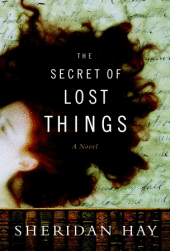
The Secret of Lost Things by Sheridan Hay


I found this book on Flashlight Worthy's list of Literary Thrillers for Book Lovers. Well, it was less literary than I'd hoped, and the "thriller" was more of a subdued mystery that detailed a long lost Melville manuscript. While the book-lover in me liked the details of the novel and its incorporation of all things bookish, I thought that the overall story was lacking. For one, it was about 100 pages to long. I realized I was halfway through the novel and still waiting for something to happen. Hay takes much to long to set up a plot that climatically disappoints. I'm all for a lengthy exposition if the rest of the novel delivers. This one did not.

Throughout the ladder half of the novel I found myself reading quickly and intently so I could find out how it ended and so it would do just that; end. I hadn't wasted 300 pages just to put the book down and not find out if the Melville manuscript existsted and the story behind it. So, in that regard, the novel was somewhat "flashlight worthy". But, I've now learned that "flashlight worthy" isn't synonmous with "a great book".

As far as mysteries go, this one was set up just fine, and was made more exciting because it revolved around stolen manuscripts and famous american authors and their secrets, but the execution was lacking. Certain details didn't add up, like why didn't Rosemary read the shred of paper from the letter before she destroyed it? She had weeks!

Like I said, the only thing that made this book tolerable were the literary references, which I enjoyed.
It was my own fault. The fault of a girl who had loved the likes of Pip, Darcy, Knightly, Mr. Rochester (all the usual suspects) without genuinely registering their common quality - they were fictional.
Other than these details that made me smile and the fact that most of the story took place in a fabulous bookstore, I wasn't impressed.

I should also mention that while this particular book wasn't up my alley, I have found many great books from Flashlight Worthy recommendations, including others that were on this very list (for instance, The Shadow of the Wind).  Yes, I still have faith in Flashlight Worthy. 

Publisher: Doubleday, 2006

9.22.2010

A Child's Calendar - John Updike

Today is the first day of autumn, the start of my favorite season.


A Child's Calendar
by John Updike

The stripped and shapely
Maple grieves
The ghosts of her
Departed leaves.

The ground is hard,
As hard as stone.
The year is old,
The birds are flown.

And yet the world,
In its distress,
Displays a certain
Loveliness---

9.21.2010

That bookstores are such places is always hoped for...

Reading now: The Secret of Lost Things by Sheridan Hay

When I was looking for new mysteries/dark fiction to read for the R.I.P. Challenge I stumbled across The Secret of Lost Things on a Flashlight Worthy List Literary Thrillers for the Book Lover. The synopsis explains the book is "a literary adventure that captures the excitement of discovering a long-lost manuscript by a towering American writer and an evocative portrait of life in a bookstore very reminiscent of the world-famous Strand." In the novel, the bookstore meant to represent The Strand is named "The Arcade".


So, The Stand is my all-time favorite bookstore and I knew had to immediately buy this book; fifty pages in and it is living up to it's potential. Here is a beautiful passage that uniquely captures the experience and abidance of The Strand.
Understand, The Arcade itself is a city; itself, an island. That bookstores are such places is always hoped for but The Arcade is like the original wish behind such hopes. The Arcade was population, mass, the accomplishment of a city. Books were stacked like teeming New Yorkers, invisible inside their buildings, but sensed as bees in a hive. The hum of life issuing from the crowds that filled the city I had begun to experience, but in The Arcade that buzzing life was made calculable in things. Chaps always told mother and me books were minds on the shelf. Here is seemed true, books didn't seem inanimate, a kind of life rose from the piles heaped on tables before me.

9.20.2010

Banned Books Week and My Favorite Banned Books


Banned Books Week is September 25 - October 2 and the best way to celebrate is to read a banned book! (Or, if you're feeling really ambitious, check out what else you can do.) Banned book week celebrates our freedom to read and began in 1982 in response to an increase in challenges to books across America's libraries, schools and bookstores. Everything from contemporary literature to the classics have been challenged, namely for exploring controversial topics.

I haven't decided what book I'll read yet, but I do want to share with you my favorite banned books I have read in the past:

Lolita, Vladimir Nabokov
Silas Marner, George Eliot
A Light in the Attic, Shel Silverstein
The Handmaid's Tale, Margaret Atwood
The Bluest Eye, Toni Morrison
Animal Farm, George Orwell
The Witches, Roald Dahl

9.17.2010

Treasure Island by Robert Louis Stevenson


I chose to read this book for the R.I.P challenge, a challenge that celebrates " things that go bump in the night; that favorite detective that always gets his man, or woman, in the end; that delicious chill of a creak on the stairs, of the rogue waiting in the dark, of the full moon and the flit of bats wings".

I've been saving Treasure Island for this time of year and it turned out to be a fun read. First published in 1883, the novel details a young man's journey to Treasure Island aboard The Hispaniola. He is accompanied by other sailors, who are in search of a treasure, and eventually turn against one another to create a battle between good an evil - the evil which is represented by the carefree, reckless pirates who are in conflict with the virtuous and upstanding Englishmen.
This novel is less of an adventure story and more of a "coming of age" narrative. We watch the young man Jim cry for his mother at the start of the novel and evolve into a hero by the close of the novel, developing a strong sense of self.
I clung with both hands till my nails ached, and I shut my eyes as if to cover up the peril. Gradually my mind came back again, my pulses quieted down to a more natural time, and I was once more in possession of myself.
As mentioned above, Stevenson also explores the relationship between good and evil and implies that they are inextricably linked together, as no one can be fully virtuous or fully immoral. Even those who seem intrinsically debauched can always have a layer of morality buried deep down, as demonstrated by Long John Silver.

I'm happy I read Treasure Island but I've got to say I enjoyed Stevenson's later work, The Strange Case of Dr. Jekyll and Mr. Hyde (1886) much more. I'm not sure one is better than the other, it's just that the type of suspense and detail in the latter appeal more to me.

Publisher: Barnes & Noble Classics, 2005 (1883)

9.16.2010

Oprah's Final Book Club Selection


Oprah began her final "farewell" season this Fall and tomorrow, she will announce her final selection for her book club. Everyone is wondering whether she will chose Jonathan Franzen's Freedom or Nelson Mandela's Conversations With Myself. Of course we all know what happened in 2001 when Oprah wanted Franzen's The Corrections in her club - Franzen wasn't happy, stating that Orpah "picked some good books, but she's picked enough schmaltzy, one-dimensional ones that I cringe".

Of course Oprah is hugely influential in the publishing world. Not only have her book club selections made millions - some have gone on to be reviewed by the New York Times, sometimes as the cover story, and have been translated to the big screen.
"The all-powerful Oprah Book Club is not so much a book club as a ruthlessly influential marketing vehicle, with the power to fundamentally alter best-seller lists, Amazon rankings and royalty payments." -Time Magazine
So, Mandela or Franzen? My vote is on Mandela.

Update: I guess we don't have to wait until tomorrow. The AP says she picked Freedom. I wonder if we will hear anything from Franzen?