10.23.2012

Post Office by Charles Bukowski


 "I didn't make for an interesting person. I didn't want to be interesting, it was too hard."

Post Office is Bukowski's first novel. Up until it was published he was focused on writing poetry. I finished this book about four weeks ago and never got around to writing a review. I just starting reading Bukowski this year, and he's quite the guy. Post Office follows Bukowski's alter ego, Henry Chianski, while he's an employee of the US post office. There isn't much in terms of plot. Instead, we follow Henry through his day-to-day; waking up with hangovers, dragging himself to work, seducing women, boozing, and repeating it all the next day. (Bukowski himself worked at the US post office for 11 years before he quit at the age of 50 to pursue writing full-time.)

Bukowski is very direct in terms of language and subject matter - he discusses sex, women, and booze in a way that would easily offend a lot of people. I admit there were certain passages that grossed me out - like when he discussed his bowel movements with adjectives like "good" and "hot". But I also I found some of these bits to be humorous and smart - exposing human nature in an honest and amusing way.
"The midget was married to a very beautiful girl. When she was in her teens she got a coke bottle trapped in her p*ssy and had to go to a doctor to get it out, and, like in all small towns, the word got out about the coke bottle, the poor girl was shunned, and the midget was the only taker. He'd ended up with the best piece of ass in town."
Post Office is about a drifter, an alcoholic who doesn't aspire to be anything more than he already is. It's dry, it's crude and it's rough; it's filled with profanities, violence, and sex. Bukowski supposedly wrote the novel in just three weeks after Black Sparrow Press offered to pay him to quit the post office to write full-time. I have to say I enjoyed Ham on Rye more than this one because it was more plot focused and less of a character study, but if you like Bukowski, Post Office is still worth the read.

Publisher: Ecco, 1971

10.18.2012

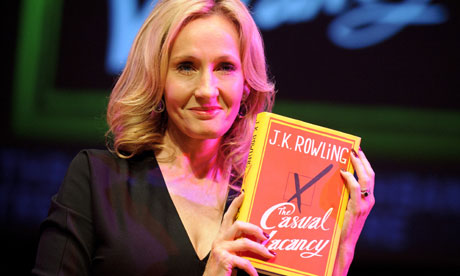
The Casual Vacancy by JK Rowling: A Late Read-Along Post


Alright, a week after I was supposed to, I finished The Casual Vacancy. Am I glad I read it? Yes. Will it be one of my favorite reads this year? No. I liked the end well enough; it was powerful and memorable (albeit a bit contrived), but the rest of the novel was on the slower side. I felt the middle could have been edited down, as there were large sections that dragged. I will say if you have the perseverance to make your way though the middle, I think you'll be happy you did by the end. But the getting there was though for me; whenever I'd put down the book, I wasn't dying to pick it back up. I'm not exactly sure if it was me or the book but regardless, I felt no sense of urgency to finish this. (Clearly, as I missed our last read-along post, and I was hosting.)

Before the book was released, critics joked that an alternate title for the novel could have been Mugglemarch, pointing to it's similarities to George Eliot's Middlemarch, a book I've read twice and respect greatly. The main similarity I noted between The Casual Vacancy and Eliot's classic is that both revolve around a plethora of characters who are all interconnected in a web of dishonesty. That, and both novels lean towards the depressing side of human nature. But that's human nature; it's irrational, selfish, and ignorant. Rowling's novel explores this less than glamorous side of human nature, exposing its weaknesses through a number of imperfect characters. 

He never seemed to grasp the immense mutability of human nature, nor to appreciate that behind every nondescript face lay a wild and unique hinterland like his own.
The last thing I want to do is compare The Casual Vacancy to Harry Potter but what I will say is that if anything, Harry Potter proved that not only does Rowling have an incredible imagination, but she's got a gift for conveying her richly imagined worlds through her writing. In my opinion, there was nothing very imaginative about this novel. Of the ideas she presented, there was nothing new in the way she brought them forth. I did not feel challenged while reading her book (if you don't count my difficulty to finish it) and it all felt a bit mundane. What I will say is Rowling proved she can write adult fiction and she can write it well - her prose is crafted beautifully and her characters are well developed. I'm just hoping that her next novel is more absorbing and a little less trite. 

Publisher: Little, Brown 2012 

Read my initial thoughts on the novel here. I'd also like to thank Beth at Bookworm Meets Bookworm once more for co-hosting the read-along and for designing the lovely button you see above. 

10.11.2012

The Casual Vacancy: A Read-Along Part 2 (Sort Of)


Today we you are posting our final thoughts on The Casual Vacancy. 

So, you guys, I'm just going to come out and say it; I did not finish the book. This is not a DNF because it's horrible, it's a momentary DNF because I have been crunched for time. I am a terrible host and I apologize, because it's a total buzz kill to sign up for a read-along and then have a terrible host. I could get into things like the 3-day wedding festivities I partook in over the weekend and the extra hours I've been putting in at work, but I'll just say I feel like an ass and that's that.

Please feel free to link up your final thoughts below. I will post my final thoughts upon completion and come back to the linkup to read yours. Until then, please accept my apologies and know that I feel terrible.


10.04.2012

The Casual Vacancy: A Read-Along Part 1


Today we are posting our general and early impressions of the novel with NO spoilers. So even if you aren't participating in the read-along, feel free to read on!

It has been one week since The Casual Vacancy was published and I've made it through the first third of the novel. I was a bit overwhelmed with the first few chapters, as we were introduced to a new character on every page, or so it seemed. As I read on things started to come together, only to become a bit stagnant. Yes, so far, I am not head over heels. This isn't to say it's bad; Rowlings writing is fantastic. She can certainly capture a feeling or detail in a way that allows me to imagine it wholly. However, in terms of plot and even character development it feels a little bland. To be fair though, I am only a third of the way through and I have no doubt things will (hopefully) pick up.

From what I've read so far, one device that stands out is Rowling's portrayal of Pagford and its foil, Yarvil. Pagford represents the "English idyll... cupped in a hallow between three hills, one of which was crested with the remains of the twelfth-century abbey. A thin river snaked around the edge of the hill and through town, straddled by a toy stone bridge."  Of course this is in contrast to the long-hated town of Yarvil, filled with unemployed drug addicts who frequent rehab. When social worker Kay Bawden visits a family in Yarvil, she notes the griminess of it all:

Bits of rubbish had tumbled or been scattered over the scrubby patch of lawn, but the bulk of it remained piled beneath one of the two downstairs windows. A bald tire sat in the middle of the lawn... After ringing the doorbell, Kay noticed a used condom glistening in the grass beside her feet, like the gossamer cocoon of some huge grub.
In my opinion, Rowling has succeeded in establishing a detailed and impressive sense of place that encompasses these two contrasting towns - now I'd like to see where this leads. Like I mentioned before, as far as characters go, there are many. I'm starting to get a better sense of what drives each and exactly how varied they all are. Thus far, I'd have to say I really enjoy Andrew. Maybe I have taken a liking because he is an underdog of sorts, or maybe it's because I find his thoughts damn funny. Either way, I look forward to learning what Andrew has got in store for us. It seems as though he may turn out to be a moderator of sorts, in contrast to his hard-headed father.

In addition, I would like to address all the body parts Rowling describes; we have encountered, thus far, balls, penises, breasts, and boners. We read a confession from a virgin who exclaims "Lots of pushing to get in properly. It's tighter than I thought". These descriptions don't feel out of place and I think they add even more color to an already diverse novel. 

All in all, do I love The Casual Vacancy? Not yet, though it may be too soon to tell. What I will say is I'm happy to read something so different from Harry Potter. Regardless of any expectations I had going into this, I was not expecting a story like this. And for that, I'd like to congratulate Rowling.

If you are participating in the read-along, feel free to link up your first post below! We will be posting our final thoughts next Thursday.


10.02.2012

The Round House by Louise Erdrich


One of the most revered novelists of our time—a brilliant chronicler of Native-American life—Louise Erdrich returns to the territory of her bestselling, Pulitzer Prize finalist The Plague of Doves with The Round House, transporting readers to the Ojibwe reservation in North Dakota. It is an exquisitely told story of a boy on the cusp of manhood who seeks justice and understanding in the wake of a terrible crime that upends and forever transforms his family. Riveting and suspenseful, arguably the most accessible novel to date from the creator of Love Medicine, The Beet Queen, and The Bingo Palace, Erdrich’s The Round House is a page-turning masterpiece of literary fiction—at once a powerful coming-of-age story, a mystery, and a tender, moving novel of family, history, and culture.

The Round House was the first Louis Erdrich novel I have read and I’m already looking forward to reading more. In this novel, Erdrich examines the Ojibwe's modern-day culture, the discrimination they face, and the conflicts and complications of their justice system as a result of jurisdiction. Specifically, if a crime is committed against an Ojibwe member on non-Native American soil, the crime cannot be tried in the Ojibwe legal system. When I first heard about this novel I pegged it for a powerful book that could expose me to a way of living with which I was not very familiar and Erdrich delivered. This is a novel that will pull at your heart strings and make you reconsider the rights and tangle of laws surrounding Native Americans.                                                                                                   
"We want the right to prosecute criminals of all races on all lands within our original boundaries... What i am doing now is for the future, though it may seem small, or trivial, or boring, to you."
First and foremost, The Round House is a coming-of-age story narrated by thirteen-year-old Joe Bazil, who is young enough to not yet be a man but too old to be considered just a kid. We as readers piece together and understand details of the crime and his family’s unfolding just as he does. There is something to be said about an innocent narrator who doesn’t deserve the reality with which he is faced and the amount of sympathy we as readers feel. 

The title of the book itself refers to a sacred meeting place, where the Ojibwe gather to worship and hold significant gatherings. In this novel, the Round House is also the scene of a heinous crime. (Not a spoiler – this is revealed in the first 100 pages.) The fact that sacred space saw such a horrible crime highlights the underlying Ojibwe traditions that were violated as a result of this crime, in addition to the Bazil family itself.

Among other things, I enjoyed that Erdich weaves details of the traditions and stories of Ojibwe culture into the narrative. In the novel ghost expose themselves and wendigos seek to possess humans. Erdich also emphasizes the tremendous support extended families provide for one another in this culture. All in all, this is a story about injustices and how a family pulls together in the wake of tragedy. It’s a story of redemption and speaks to the prejudice many Native American women face across our nation. If you do read this novel, and I recommend that you do, be sure to read the afterward; it details sobering statistics that I think would be considered spoilers if I included them here.

Publisher: Harper, 2012

9.20.2012

JK Rowling's The Casual Vacancy: A Read-Along


Beth at Bookworm Meets Bookworm and I are so excited about the release of Rowling's first novel for adults that we decided to host a read-along! We both knew we'd read it immediately upon its release, so it only makes sense to ask you to join in and read it with us! If you've been living under a rock, the synopsis of the novel is as follows:

When Barry Fairbrother dies in his early forties, the town of Pagford is left in shock.
Pagford is, seemingly, an English idyll, with a cobbled market square and an ancient abbey, but what lies behind the pretty façade is a town at war. Rich at war with poor, teenagers at war with their parents, wives at war with their husbands, teachers at war with their pupils...Pagford is not what it first seems. And the empty seat left by Barry on the parish council soon becomes the catalyst for the biggest war the town has yet seen. Who will triumph in an election fraught with passion, duplicity and unexpected revelations?


As far as read-alongs go, this one will be pretty informal, with just two posts. Since this will most likely be a novel we can burn through, we've allotted two weeks for the schedule. The novel will be published a week from today, Thursday, September 27th. 

The first post will be Thursday, October 4th and will include first impressions and general thoughts, really anything you'd like to discuss is fair game but NO SPOILERS! Since there isn't a set page number you need to get to before the first post, we don't want to ruin anything for anyone else participating.

The second and final post will be Thursday, October 11th when we will wrap up the discussion with our overall impression of the novel. This may include an examination of its themes and motifs, character development, or how you felt about Rowling's first first novel for adults compared to the Harry Potter phenomenon she created. Again, you can discuss anything you want and at this point, and spoilers are fair game. This probably goes wihtout saying, but when you post final thoughts you should have the novel completed.

Okay, formalities aside, we really just planned this read-along as a means to have fun and promote discussion! If you are thinking about reading the novel right away and want to join in, grab the button and link up! Also a big thanks to Beth for making an awesome button! 


9.17.2012

The Eyre Affair by Jasper Fford


“Governments and fashions come and go but Jane Eyre is for all time.”

I'm a little late to the Thursday Next party, but I'm happy to now be a part of it! The Eyre Affair is the first novel of the Thursday Next Series and it was such a fun read. Fford has created an alternate history in which the lines between reality and fiction become blurred and people can literally step into the pages of a book, meet its central characters, and experience the setting for themselves. With that they can also manipulate the outcome of the novel and even kidnap fictional characters. Enter LiteraTec Thursday Next, a literary protector of sorts, working to maintain the authenticity of great works of literature.

The barriers between reality and fiction are softer than we thing; a bit like a frozen lake. Hundreds of people can walk across it, but then one evening a thin spot develops and someone falls through; the hole is frozen over by the following morning.
If you haven't already guessed, this is definitely a book for book lovers as it's filled with literary references. I don't want to give away much of the plot, because the not knowing is what makes it so enjoyable. The story is incredibly imaginative and odd, but I mean that in the best possible way. I will say it took me about 100 plus pages to really get into the book, so don't get discouraged if you pick it up and feel confused or removed; if you keep going I promise you will be rewarded in the second half of the novel. I should also mention you'll probably enjoy this book much more if you have already read or are very familiar with Jane Eyre. I wouldn't say Rochester and Jane are main characters per se, but their story is at the forefront of the novel (hence the title The Eyre Affair) and the bits in which they appeared were among my favorite parts of the book. Fford did a great job maintaining the genuine feel of the characters and I appreciated the novel that much more because of those details.

All in all this was a fun, substantial read. I'd recommend it to anyone who enjoys studying literature and those who love Jane Eyre. A special thanks to Alley for recommending this book so highly. There are currently a total of seven books in the Thursday Next series and I look forward to picking up the second, Lost In a Good Book.


Publisher: Penguin, 2001

9.11.2012

Books That Make You Think


This week's top ten Tuesday gives me a chance to highlight some of my favorite kinds of books; those that make you think. Allow me to elaborate - these are books that examine an issue that doesn't have a "right" or "wrong" answer ; these books present both sides of an issue, open your eyes to it, and make you really think about about where you stand, or make you question what you thought you believed in the first place. For me, these books tend to be the most powerful and the most memorable.

Native Son by Richard Wright / What you'll consider: Civil rights; discrimination in the American judicial system; racism; generational poverty

Zeitoun by Dave Eggers / What you'll consider: What in means to be an American Muslim post 9/11; racial profiling; hypocrisy of governments

People Who Eat Darkness by Richard Llyod Parry / What you'll consider: Eastern vs. Western culture in terms of media, law, sexual behavior and government; how culture determines gender roles

The Submission by Amy Waldman / What you'll consider: What it means to be an American Muslim post 9/11; government propaganda; the non-apologetic attitude of modern-day America; the irrationality of certain post 9/11 fears


them by Joyce Carol Oates / What you'll consider:
Poverty in America; class struggle; the role of women

Animal Farm
by George Orwell / What you'll consider: The problems that arise from absolute power/totalitarian regimes; political corruption; the human desire for power

Middlesex by Jeffrey Eugindes / What you'll consider: Cultural history; divided identities; the impact one has on the lives around him or her; gender vs. sex

11/22/63
by Stephen King / What you'll consider: The power of "what if;" the idea that the past it obdurate; 


The Reluctant Fundamentalist by Moshin Hamid
/ What you'll consider: What it means to be a Muslim in post 9/11 America; the ever-changing American landscape and its consequences


Life of Pi by Yann Martel / What you'll consider: Faith; religion; free will

As I said, these kind of books tend to be my favorite kind of read, so please feel free to leave any recommendations in the comments!   
image via weheartit.