Showing posts with label read-along. Show all posts

10.18.2012

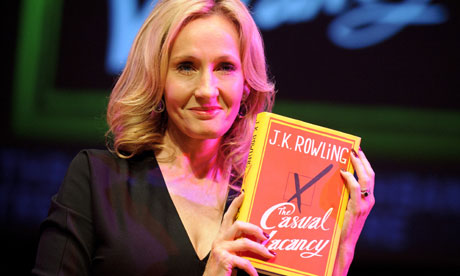
The Casual Vacancy by JK Rowling: A Late Read-Along Post


Alright, a week after I was supposed to, I finished The Casual Vacancy. Am I glad I read it? Yes. Will it be one of my favorite reads this year? No. I liked the end well enough; it was powerful and memorable (albeit a bit contrived), but the rest of the novel was on the slower side. I felt the middle could have been edited down, as there were large sections that dragged. I will say if you have the perseverance to make your way though the middle, I think you'll be happy you did by the end. But the getting there was though for me; whenever I'd put down the book, I wasn't dying to pick it back up. I'm not exactly sure if it was me or the book but regardless, I felt no sense of urgency to finish this. (Clearly, as I missed our last read-along post, and I was hosting.)

Before the book was released, critics joked that an alternate title for the novel could have been Mugglemarch, pointing to it's similarities to George Eliot's Middlemarch, a book I've read twice and respect greatly. The main similarity I noted between The Casual Vacancy and Eliot's classic is that both revolve around a plethora of characters who are all interconnected in a web of dishonesty. That, and both novels lean towards the depressing side of human nature. But that's human nature; it's irrational, selfish, and ignorant. Rowling's novel explores this less than glamorous side of human nature, exposing its weaknesses through a number of imperfect characters. 

He never seemed to grasp the immense mutability of human nature, nor to appreciate that behind every nondescript face lay a wild and unique hinterland like his own.
The last thing I want to do is compare The Casual Vacancy to Harry Potter but what I will say is that if anything, Harry Potter proved that not only does Rowling have an incredible imagination, but she's got a gift for conveying her richly imagined worlds through her writing. In my opinion, there was nothing very imaginative about this novel. Of the ideas she presented, there was nothing new in the way she brought them forth. I did not feel challenged while reading her book (if you don't count my difficulty to finish it) and it all felt a bit mundane. What I will say is Rowling proved she can write adult fiction and she can write it well - her prose is crafted beautifully and her characters are well developed. I'm just hoping that her next novel is more absorbing and a little less trite. 

Publisher: Little, Brown 2012 

Read my initial thoughts on the novel here. I'd also like to thank Beth at Bookworm Meets Bookworm once more for co-hosting the read-along and for designing the lovely button you see above. 

10.11.2012

The Casual Vacancy: A Read-Along Part 2 (Sort Of)


Today we you are posting our final thoughts on The Casual Vacancy. 

So, you guys, I'm just going to come out and say it; I did not finish the book. This is not a DNF because it's horrible, it's a momentary DNF because I have been crunched for time. I am a terrible host and I apologize, because it's a total buzz kill to sign up for a read-along and then have a terrible host. I could get into things like the 3-day wedding festivities I partook in over the weekend and the extra hours I've been putting in at work, but I'll just say I feel like an ass and that's that.

Please feel free to link up your final thoughts below. I will post my final thoughts upon completion and come back to the linkup to read yours. Until then, please accept my apologies and know that I feel terrible.


10.04.2012

The Casual Vacancy: A Read-Along Part 1


Today we are posting our general and early impressions of the novel with NO spoilers. So even if you aren't participating in the read-along, feel free to read on!

It has been one week since The Casual Vacancy was published and I've made it through the first third of the novel. I was a bit overwhelmed with the first few chapters, as we were introduced to a new character on every page, or so it seemed. As I read on things started to come together, only to become a bit stagnant. Yes, so far, I am not head over heels. This isn't to say it's bad; Rowlings writing is fantastic. She can certainly capture a feeling or detail in a way that allows me to imagine it wholly. However, in terms of plot and even character development it feels a little bland. To be fair though, I am only a third of the way through and I have no doubt things will (hopefully) pick up.

From what I've read so far, one device that stands out is Rowling's portrayal of Pagford and its foil, Yarvil. Pagford represents the "English idyll... cupped in a hallow between three hills, one of which was crested with the remains of the twelfth-century abbey. A thin river snaked around the edge of the hill and through town, straddled by a toy stone bridge."  Of course this is in contrast to the long-hated town of Yarvil, filled with unemployed drug addicts who frequent rehab. When social worker Kay Bawden visits a family in Yarvil, she notes the griminess of it all:

Bits of rubbish had tumbled or been scattered over the scrubby patch of lawn, but the bulk of it remained piled beneath one of the two downstairs windows. A bald tire sat in the middle of the lawn... After ringing the doorbell, Kay noticed a used condom glistening in the grass beside her feet, like the gossamer cocoon of some huge grub.
In my opinion, Rowling has succeeded in establishing a detailed and impressive sense of place that encompasses these two contrasting towns - now I'd like to see where this leads. Like I mentioned before, as far as characters go, there are many. I'm starting to get a better sense of what drives each and exactly how varied they all are. Thus far, I'd have to say I really enjoy Andrew. Maybe I have taken a liking because he is an underdog of sorts, or maybe it's because I find his thoughts damn funny. Either way, I look forward to learning what Andrew has got in store for us. It seems as though he may turn out to be a moderator of sorts, in contrast to his hard-headed father.

In addition, I would like to address all the body parts Rowling describes; we have encountered, thus far, balls, penises, breasts, and boners. We read a confession from a virgin who exclaims "Lots of pushing to get in properly. It's tighter than I thought". These descriptions don't feel out of place and I think they add even more color to an already diverse novel. 

All in all, do I love The Casual Vacancy? Not yet, though it may be too soon to tell. What I will say is I'm happy to read something so different from Harry Potter. Regardless of any expectations I had going into this, I was not expecting a story like this. And for that, I'd like to congratulate Rowling.

If you are participating in the read-along, feel free to link up your first post below! We will be posting our final thoughts next Thursday.


9.20.2012

JK Rowling's The Casual Vacancy: A Read-Along


Beth at Bookworm Meets Bookworm and I are so excited about the release of Rowling's first novel for adults that we decided to host a read-along! We both knew we'd read it immediately upon its release, so it only makes sense to ask you to join in and read it with us! If you've been living under a rock, the synopsis of the novel is as follows:

When Barry Fairbrother dies in his early forties, the town of Pagford is left in shock.
Pagford is, seemingly, an English idyll, with a cobbled market square and an ancient abbey, but what lies behind the pretty façade is a town at war. Rich at war with poor, teenagers at war with their parents, wives at war with their husbands, teachers at war with their pupils...Pagford is not what it first seems. And the empty seat left by Barry on the parish council soon becomes the catalyst for the biggest war the town has yet seen. Who will triumph in an election fraught with passion, duplicity and unexpected revelations?


As far as read-alongs go, this one will be pretty informal, with just two posts. Since this will most likely be a novel we can burn through, we've allotted two weeks for the schedule. The novel will be published a week from today, Thursday, September 27th. 

The first post will be Thursday, October 4th and will include first impressions and general thoughts, really anything you'd like to discuss is fair game but NO SPOILERS! Since there isn't a set page number you need to get to before the first post, we don't want to ruin anything for anyone else participating.

The second and final post will be Thursday, October 11th when we will wrap up the discussion with our overall impression of the novel. This may include an examination of its themes and motifs, character development, or how you felt about Rowling's first first novel for adults compared to the Harry Potter phenomenon she created. Again, you can discuss anything you want and at this point, and spoilers are fair game. This probably goes wihtout saying, but when you post final thoughts you should have the novel completed.

Okay, formalities aside, we really just planned this read-along as a means to have fun and promote discussion! If you are thinking about reading the novel right away and want to join in, grab the button and link up! Also a big thanks to Beth for making an awesome button! 


6.03.2012

Alias Grace: Read-Along, Part 2


My apologies for not getting this post up on time. I've been crazy busy with a new job and a bunch of late-May birthday activities (my mother, Ryan, and Ryan's mother - have I mentioned both of our mother's names are Annette? Spooky.) that I was able to finish the book on time, but didn't have a chance to post my final thoughts. Better late than never, right?

Warning: final thoughts contain spoilers.

Anyhow, back to Alias Grace. Man, is this book a mind-f*ck, and I'm saying that in the best possible way. The novel follows Grace Marks, a 16-year-old Canadian servant girl who is convicted of the murder of her employer and his mistress. It takes place in the mid 1800's and lays out Grace's past and the controversy surrounding her trail; many believed her to be innocent while others vehemently encouraged her incarceration. Grace herself claims to have no memory of the night these murders took place. The story is told in a double narrative with chapters alternating from Grace's story, to the point of view of Dr. Simon Jordon, the doctor who is interviewing her in hopes of bringing her memories of the crime to the surface. The story itself is a patchwork, combining a variety of actual interview snipits and Atwood's own take on the story. The murders themselves were sensationalized to the point that Grace Marks became one of the most well-known criminals in 19th century Canada. We aren't ever given a definitive answer as to what truly happened, but rather allowed to decide for ourselves as Atwood outlines the details, both fictional and factual, for us.

One reoccurring theme that struck me from the beginning of the novel and remained prominent throughout was the idea that nothing is what it seems. I found this theme especially prominent when Grace described her dreams, or we were taken into a dream sequence of hers. Things she saw or touched quickly transformed into something artificial. Grace describes a detailed dream in the second half of the novel, to which she ends with this:
But as my sight cleared, I saw that they were not birds at all. They had a human form, and they were the angels whose white robes were washed in blood, as it says at the end of the Bible; and they were sitting in silent judgment upon Mr. Kinnear's house, and on all within it. And then I saw that they had no heads.
Many of my favorite novels are those that don't outwardly explain what exactly happens, but instead let the reader decide. With that said, I felt that I had a hard time fully getting into this novel, as the narration was very distanced and the tone quite bitter. I can see why many readers mark this novel for a reread; there are so many details to digest and so many pieces to the novel, some that fit and others that don't. I think I could extract a lot more from this novel through a reread.

In addition, the story as a whole was more subtle than I expected. There was a great deal that told about Grace's everyday life as a servant and the lead up to the murders themselves comprised two-thirds of the book. Considering the novel dealt with topics of murder, possession, and infidelity, as a whole it felt rather subdued. I'm not saying this was a bad thing per se, just very unexpected.

There was a part of me that wanted the events to feel more heated, more immediate. Because there was so much sensationalism surrounding the actual murder, I thought Atwood might employ that energy and feeling into the novel itself. Instead, as I mentioned above, there was a lot of focus on the day-to-day of Grace's chores and her servant life. While I did enjoy those bits, I felt like I was waiting for something more. When I finally did get into it, I was intrigued, but also somewhat let down. I wish there would have been more excitement leading up to the climax, or at least more of a focus on Grace's possession. Without it, I felt that the book could have been more condensed. However, with that said, the quiet craziness is the theme that Atwood does well. I've come to expect a lack of definition in her denouements and a plethora of complications in her straightforwardness.

All in all, this isn't my favorite Atwood (Cat's Eye still holds that spot) but I did enjoy the reading experience, nonetheless. Atwood did a fantastic job capturing the feeling of the period, and I'd like to see her write more historically based fiction. I'm also so happy I participated in the read-along, as this book was a fantastic choice for discussion among other bloggers.

Publisher: Bloomsbury, 1996

5.16.2012

Alias Grace: A Read-Along, Part 1


Today we are posting our general and early impressions of the novel with NO spoilers. So even if you aren't participating in the read-along, feel free to read on!

According to my Goodreads, I have read 51% of this novel so far. If I had to classify this novel from the amount I've read so far, I'd call it part historical fiction, part physiological mystery. Alias Grace follows Grace Marks, a 16-year-old Canadian housemaid who is convicted of the murder of her employer and his mistress. The novel takes place in the mid 1800's and lays out Grace's past and the controversy surrounding her trail; many believed her to be innocent while others vehemently encouraged her incarceration. Grace herself claims to have no memory of the night these murders took place. The story* is told in a double narrative with chapters alternating from Grace's story, to the point of view of Dr. Simon Jordon, the doctor who is interviewing her in hopes of bringing her memories of the crime to the surface.

What struck me from the start was the first person narrative from Grace herself. Atwood rarely writes in a first person narrative and I have to say I am enjoying this departure. Grace's voice is dispassionate, yet compelling. However, I sense that Grace is not a trustworthy narrator, unreliable if you will. Since we aren't giving away spoilers I won't mention the details that led me to this hunch, but suffice it to say there are many suspicions that arise for me a reader.

Another notable aspect of the novel is it's structure. Between chapter sections there are epigraphs that consist of passages, poetry, and historical documents that offer further insight into the historical background of the case and reinforce themes and motifs that are prevalent in the narrative. Most notably, Atwood explores the politics behind cases such as Grace's and the role the media plays in the outcomes of these cases. From the start of the novel details of the case are ambiguous and the reader isn't told what to believe. We are left to make up our own mind, but given little (as of yet) concrete evidence and facts. There aren't many people left whose whereabouts are known with whom Dr. Simon can corroborate Grace's story which means that so far, we haven't been able to find out whether she is telling the truth or lying.

Although the novel is on the darker side and the subject matter quite serious, Atwood injects bits of humor throughout which adds to the fun of reading it. Of course the novel is beautify written, as I have come to expect any Atwood novel to be. Her passages glow with visceral details and eloquent prose.
"All the same, murderess is a strong word to have attached to you. It has a smell to it - that word - musky and opressive, like dead flowers in a vase. Sometimes at night I whisper it to myself: murderess, murderess. It rustles, like a taffeta skirt across the floor."
All in all, so far this is a good read. It started off strong, staggered a bit (for me at least), but it's coming back around. The more I read, the more I don't want to put the book down. I hope that by the end of the novel we are given answers, but given the ambitiousness of the first half of the novel, I've got a sneaky feeling we may be left in the dark a bit.

Want to hear more? Visit Bookish Habits and Bookworm Meets Bookworm to read more initial thoughts! We will be posting our final thoughts of the novel Wednesday, May 30th. (I know there are a handful of others participating, so please let me know who you are so I can link you as well.)

*It is worth noting that although this is a work of fiction, there was a case that took place in Canada involving Grace Marks, a young woman tried for the murders of her employers and his mistress.

4.05.2012

Alias Grace: A Read Along


Zeteticat, Beth and I talked about an Alias Grace read along a few weeks back on twitter and we are making it happen. The novel is one of Atwood's more popular works. It won the Canadian Giller prize and was shortlisted for the Booker Prize and the Orange Prize.

A synopsis from Goodreads: In Alias Grace, bestselling author Margaret Atwood has written her most captivating, disturbing, and ultimately satisfying work since The Handmaid's Tale. She takes us back in time and into the life of one of the most enigmatic and notorious women of the nineteenth century. Grace Marks has been convicted for her involvement in the vicious murders of her employer, Thomas Kinnear, and Nancy Montgomery, his housekeeper and mistress. Some believe Grace is innocent; others think her evil or insane. Now serving a life sentence, Grace claims to have no memory of the murders. Dr. Simon Jordan, an up-and-coming expert in the burgeoning field of mental illness, is engaged by a group of reformers and spiritualists who seek a pardon for Grace. He listens to her story while bringing her closer and closer to the day she cannot remember. What will he find in attempting to unlock her memories? Is Grace a female fiend? A bloodthirsty femme fatale? Or is she the victim of circumstances?

This read along is going to be on the casual side with two scheduled posts. There isn't a certain amount of pages that need to be completed for the first post, but the book should be finished when you post final thoughts.

First post Wednesday, May16th: General and early impressions; themes and motifs that you've noticed so far, etc. No spoilers.

Last post Wednesday, May 30th: Wrap up discussion, overall impressions, etc. Truth vs fiction: likelihood this version is close to the truth. Spoilers are fair game.

It sounds like this is going to be a book that encourages discussion, so I'm really excited to be reading it as a readalong. To sign up head over to Zeteticat's Bookish Habits and leave a comment on her post. If you need another reason to sign up, Ana from Things Mean A Lot said this was her "favorite Atwood to date, which says a lot".

Photo from Zeteticat's Bookish Habits

3.02.2011

The Age of Innocence: Book Two


The Age of Innocence read-along is hosted by Beth at Bookworm Meets Bookworm. Today we are posting our thoughts on Book Two and the entire novel overall. You can read my thoughts on Book One here.

Oh Edith Wharton - she is truly fantastic. Prior to The Age of Innocence, I had only read Ethan Frome, which I liked very much. Wharton has now established herself to be a master in relating a tortured love story. But it really is much more than that. I think one of the things that makes The Age of Innocence so powerful is Wharton's ability to impose the character's emotions onto the reader. Book One concluded with the announcement that Archer's wedding had been pushed forward. We still weren't sure what would happen with Ellen and I wondered whether or not Archer would go through with the wedding. Book Two opens on Archer's wedding day. Wharton throws her readers into the event - highlighting the haste and slight confusion Archer himself undergoes. Wharton also does this to the reader in the end when we jump forward many years to learn about May's death, the birth of Archer's children and his son's engagement to Fanny Beaufort. There is a disconnection between Archer's life as we left it and the one that we now learn about.
Nothing could more clearly give the measure of the distance that the world had traveled. People nowadays were too busy - busy with reforms and "movements," with fads and fetishes and frivolities - to bother much about their neighbors. And of what account was anybody's past, in the huge kaleidoscope where all the social atoms spun around on the same plane?
In my post on Book One I mentioned that this book is almost a work of observational anthropology, critiquing our inherent societal values and rejection of the unusual. These ideas are true throughout Book Two as well. Wharton further examines Old New York society in Book two by considering its gender relations. In Book One we are lead to believe May falls short of average intelligence, but in Book Two we see her "blue eyes wet with victory" when Archer knows he must stay with her and let Ellen go. I think Wharton is highlighting the underrated astuteness of the girl who plays dumb, and the true potential they hold to get exactly what they want. Wharton also touches on the double standards of an affair and then examines them backward, insisting that a woman is prone to changing her mind and acting impetuously, and it's the man who should be at fault for adulterous actions. I found Wharton's examination of gender relations in Book Two both interesting and witty.

When reading books I am usually hesitant to believe two characters in a novel are truly in love. The author really has to show me this emotion and make it unique - in The Age of Innocence, I never doubted Archer's love for Ellen. Wharton really pulled at my heart strings when Archer picks up Ellen at the train station and states,
Do you know - I hardly remembered you?
Hardly remembered me?
I mean: how shall I explain? I - it's always so. Each time you happen to me all over again.
Now, a discussion of the ending (spoiler alert). I think Wharton really does this entire novel justice when Archer walks away from Ellen without even saying hello years later. I don't think this novel was ever just a love story, which is what it would have been had Archer and Ellen ended up together. I think this is a story about a life of regret. I think this is a novel that articulates the importance of timing in life and the mutability of of our everyday world. It's about doing what's best for those you care about and stifling selfish motivations. It highlights the repercussions of the choices we make and the inability to go back and do things differently. I think it's about understanding societal constraints and despite a yearning for something more, facing the inability to break free of those constraints. All in all, the ending as it was made me think about the book as a whole more than I would have had Ellen and Archer lived happily ever after. Well played, Edith Wharton. Well played.

The Age of Innocence won the 1921 Pulitzer Prize in fiction.

Publisher: Macmillan, 1920

2.16.2011

The Age of Innocence: Book One


The Age of Innocence Read-along is hosted by Beth at Bookworm Meets Bookworm. Today we are posting our thoughts on Book One.

The Age of Innocence earned Edith Wharton the Pulitzer Prize in 1921. Set in "Old New York," we meet Newland Archer, who represents the ultimate figure in New York society. He is recently engaged to May Welland, a marriage that will unite two of New York's oldest families. Enter Countess Ellen Olenska, May's unconventional cousin who has just returned from Europe after a failed marriage.

From the beginning of the novel Wharton evokes the feeling of high-society New York through imagery and language. The opening scene takes us to an opera, an event attended by good society; a place where one can be seen in high fashion, displaying astute manners - while also keeping a close eye on their company, keeping up with the latest social news and gossiping about others when prompted. The opera has the benefit of being "small and inconvenient," thus keeping out the "new people whom New York was beginning to dread and yet be drawn to".

Countess Olenska is one of these characters who is dreaded. She and her cousin May could not be more different. While May is eager to please with her understanding of New York society and it's social expectations, Countess Olenska is more vivacious, understanding New York to be a place where one is taken on vacation "when one has been a good little girl and done all one's lessons". Of course the passionate and unusual (if not sometimes offensive) qualities of Olenska begin to enamor Archer, intriguing him more so than his traditional and meek fiance. Soon he beings to question his engagement.
He saw his marriage becoming what most other marriages about him were: a dull association of material and social interests held together by ignorance on the one side and hypocrisy on the other.
The idea of freedom from society is a prevalent theme in book one. Early on, when defending the Countess, Archer states, "Woman ought to be free - as free as [men] are". He then goes on to feel increasingly oppressed - oppressed by societal expectations and its ridged, unimaginative mores.
And he felt himself oppressed by this creation of factitious purity, so cunningly manufactured by a conspiracy of mothers and aunts and grandmothers and long-dead ancestresses, because it was supposed to be what he wanted, what he had a right to, in order that he might exercise his lordly pleasure in smashing it like an image made of snow.
It isn't until Archer is able to free himself from the city and it's social constrains that he allows himself to fully admit his feeling toward Olenska. It's not suprising that Olenska mimics these this feeling of constraint and yearning toward freedom. After returning to New York her Grandmother wanted Olenska to live with her, to which Olenska explains she had to live on her own - she "had to be free".

Thoughts:

So far I am really enjoying this novel - more so than I thought I would. It's almost a work of observational anthropology, critiquing our inherent societal values and rejection of the unusual. It's like society itself is a main character, because it's that prevalent throughout book one. It has a constant weight and pull on each character and their actions.

Of course I am hoping Archer ends of up the Countess in the end, but he's dug himself into somewhat of a hole. After he convinces the Countess not to divorce and sue her husband (a case in which he would have headed), he realizes he is in love with her, but isn't able to marry her as long as she listens to his advice and doesn't divorce.

Also, I like the bits that describe Archer as an avid reader - getting excited about a new box of books and preferring the "prospect of a quite Sunday at home with his spoils". Later, when he can't get his mind of the Countess after his return from Highbank, he tries to read and while he "turned the pages with the sensuous joy of a book-lover, he did not know what he was reading". I think this is a feeling that all readers can relate, and I enjoy these "bookish" descriptions Wharton includes.

I've also got to say that of May and the Countess - I really relate to the Countess. I'm quite outgoing - sometimes, but rarely, to the point of obnoxious - but have never regretted this quality of mine. I think it's better to be oneself than try to squeeze into a mold that doesn't quite fit. Some of my all-time favorite literary characters have been carefree women who forge their own path regardless of what people think and Countess Olenska is certainly one of these characters. I don't think that she doesn't recognize her "misbehavior" in the sense that it goes against scoietal norms - I think it's that she doesn't care. She would rather stay true to herself and seek freedom from these constrains.

I'm really looking forward to book two. I'm hoping Archer can man-up!

1.19.2011

Edith Wharton's The Age of Innocence Read-Along


Beth over at Bookworm Meets Bookworm is hosting The Age of Innocence Read-Along and I just signed up! The Age of Innocence won the Pulitzer Prize in 1921. Until now I've only read Wharton's Ethan Frome and I'm excited to tackle another one of her titles.

The read-along will be split into two parts - Book One and Book Two - and will take place from February 2nd to March 2nd. There will be a post for each section:


If you are interested in participating (and I think you should!) you can sign up at Bookworm Meets Bookworm.