11.13.2012

The Thirteenth Tale by Diane Setterfield

 
I picked this one up for the RIP challenge, as I've heard it compared to books like Shadow of the Wind and The Book of Lost Things. I'm pretty sure I'm the last blogger to read this book, so I'm not going to do much recap. This has been called a book for book lovers as our narrator, Margaret Lea, is the operator of a bookshop and longtime bibliophile, preferring the company of books to the company of people. As the novel moves forward, Margaret finds herself working with an incredibly famous though reclusive author, Vida Winter. Winter has hired Margaret to tell the author's untold life story. The novel holds certain parallels to Victorian classics that are mentioned throughout; most notably Jane Eyre, Wuthering Heights and The Turn of the Screw, to name a few.

For me, the narrative had a few moments of suspense but overall I found the twists underwhelming and the plot filled with conveniences.  The biggest problem that I had with the book was that I found it to be over-narrated; characters and ideas rarely spoke for themselves, instead our narrator told us everything, including the obvious, and never let me assess things for myself. The narration made the story too accessible, giving it an almost juvenile, corny feel:

Everybody has a story. It's like families. You might not know who they are, might have lost them, but they exist all the same. You might drift apart or you might turn your back on them, but you can't say you haven't got them. Same goes for stories.
Aside from that it was an engaging story in parts, but lacking in its delivery. I know I'm in the minority with this one, it just didn't do it for me.

11.09.2012

Book Riot Readers’ Top 50 Favorite Novels

You know I'm a sucker for lists! Awhile back Book Riot asked its readers to vote on their top 3 favorite novels. They complied the list and posted the results. Only one of my votes made the list - The Time Traveler's Wife. The other books I voted for were Richard Wright's Native Son and Jhumpa Lahiri's The Namesake
  1. To Kill A Mockingbird by Harper Lee (126 votes)
  2. Pride and Prejudice by Jane Austen
  3. Jane Eyre by Charlotte Bronte
  4. The Harry Potter series by J.K. Rowling
  5. The Great Gatsby by F. Scott Fitzgerald
  6. The Lord of the Rings series by J.R.R. Tolkien
  7. Gone With the Wind by Margaret Mitchell
  8. Wuthering Heights by Emily Bronte
  9. The Book Thief by Markus Zusak
  10. The Catcher in the Rye by J.D. Salinger
  11. One Hundred Years of Solitude by Gabriel Garcia Marquez
  12. The Secret History by Donna Tartt
  13. Catch-22 by Joseph Heller
  14. A Tree Grows in Brooklyn by Betty Smith
  15. Slaughterhouse-Five by Kurt Vonnegut
  16. A Prayer for Owen Meany by John Irving
  17. The Stand by Stephen King
  18. The Hobbit by J.R.R. Tolkien
  19. Anna Karenina by Leo Tolstoy
  20. Infinite Jest by David Foster Wallace
  21. Persuasion by Jane Austen
  22. The Picture of Dorian Gray by Oscar Wilde
  23. The Brothers Karamozov by Fyodor Dostoevsky
  24. The Outlander series by Diana Gabaldon
  25. East of Eden by John Steinbeck
  26. The Shadow of the Wind by Carlos Ruiz Zafon
  27. The Time Traveler’s Wife by Audrey Niffenegger
  28. American Gods by Neil Gaiman
  29. The Count of Monte Cristo by Alexandre Dumas
  30. Fahrenheit 451 by Ray Bradbury
  31. 1984 by George Orwell
  32. Crime and Punishment by Fyodor Dostoevsky
  33. Little Women by Louisa May Alcott
  34. Moby-Dick by Herman Melville
  35. The Grapes of Wrath by John Steinbeck
  36. The Handmaid’s Tale by Margaret Atwood
  37. The Hitchhiker’s Guide to the Galaxy series by Douglas Adams
  38. Lolita by Vladimir Nabokov
  39. Rebecca by Daphne du Maurier
  40. Ulysses by James Joyce
  41. Cloud Atlas by David Mitchell
  42. The Perks of Being a Wallflower by Stephen Chbosky
  43. Ender’s Game by Orson Scott Card
  44. Middlesex by Jeffrey Eugenides
  45. The Amazing Adventures of Kavalier and Clay by Michael Chabon
  46. Dune by Frank Herbert
  47. Gilead by Marilynne Robinson
  48. Les Miserables by Victor Hugo
  49. The Night Circus by Erin Morgenstern 
  50. The Poisonwood Bible by Barbara Kingsolver (13 votes)
How many have you read? Go over here and let BookRiot know!  

Also, if you voted, which books did you vote for?

11.08.2012

RIP VII Reading


Halloween has come and gone and with that, I read some fantastically dark and suspenseful book for the RIP VII Challenge. I participated in Peril the Second: Read two books, any length, that you feel fits my very broad definition of scary. It could be Stephen King or Sir Arthur Conan Doyle, Ian Fleming or Edgar Allan Poe…or anyone in between. I read three novels, all of which leaned heavily in the mystery/suspense genre:

The Eyre Affair, Jasper Fford: Fford has created an alternate history in which the lines between reality and fiction become blurred and people can literally step into the pages of a book, meet its central characters, and experience the setting for themselves. With that they can also manipulate the outcome of the novel and even kidnap fictional characters. 

The Big Sleep, Raymond Chandler: This book was fun to read and knowing that it was one of the first of its kind, it's even more impressive. The novel has been adapted into film twice (1946, 1978) with the first staring Humphrey Bogart and Lauren Bacall - so you know it was a pretty big deal. Bogart of course plays Philip Marlowe, one of the more memorable characters I've read in while.

The Thirteenth Tale, Diane Setterfield: Full review coming soon, but I'm sorry to report this one didn't blow my socks off as many of you predicted it would. It was entertaining but a little too straight forward for my taste. 


If you're interested in reading brief reviews of the books I read for RIP last year, you can find that here. The books I included for my probable reads came from my list below. I still plan to read the others listed eventually.
  • Rebecca, Daphne DuMarier
  • The Gun Slinger, Stephen King
  • The Big Sleep, Raymond Chandler
  • The Thirteenth Tale, Diane Setterfield 
  • Case Histories, Kate Atkinson 
  • The Eyre Affair, Jasper Fford
  • Something Wicked This Way Comes, Ray Bradbury
  • We Have Always Lived In the Castle, Shirley Jackson 
  • In The Woods, Tana French 

11.06.2012

The Big Sleep by Raymond Chandler


"You were dead, you were sleeping the big sleep, you were not bothered by things like that, oil and water were the same as wind and air to you. You just slept the big sleep, not caring about the nastiness of how you died or where you fell."

Raymond Chandler is considered to be one of the founders of the "hard-boiled" genre, setting the stage for several generations of crime writers. This book was fun to read and knowing that it was one of the first of its kind, it's even more impressive. The novel has been adapted into film twice (1946, 1978) with the first staring Humphrey Bogart and Lauren Bacall - so you know it was a pretty big deal. Bogart of course plays Philip Marlowe, one of the more memorable characters I've read in while. He lives in a corrupt world that driven him to become cynical; he's hard-drinking lady killer who also happens to be a private detective. Chandler himself admitted to the unbelievability of Marlowe's character when he wrote, “The private detective of fiction is a fantastic creation who acts and speaks like a real man. He can be completely realistic in every sense but one, that one sense being that in life as we know it such a man would not be a private detective.”

I do not think this unbelievability took away from the novel as whole. In fact, it is this lead character and the overall atmosphere of the novel that carries it. The atmosphere is gorgeous and descriptive and everything has that old Hollywood vibe. Although the novel takes place in LA, the setting is less concerned with the city as it is with its immediate surroundings; lavish mansions overlooking the Hollywood hills, clubs that look swanky by night and seedy by day, and of course Marlowe's own dingy office. Added bonus:
I did not predict the ending before it was revealed, which made it even more fun.
 
I will say that I had to pay careful attention to the plot throughout, as it changes often, taking more turns than any other 250 page novel I've read. If I lost concentration for even a page I had to go back and reread it, because you better believe something happened to change the direction of the storyline. Aside from the somewhat confusing plot, I have no complaints. Among his other novels, Chandler wrote a total of seven Philip Marlowe titles. The Big Sleep was the first, and I definitely plan to read more.

Publisher: Vintage Crime, 1939

10.23.2012

Post Office by Charles Bukowski


 "I didn't make for an interesting person. I didn't want to be interesting, it was too hard."

Post Office is Bukowski's first novel. Up until it was published he was focused on writing poetry. I finished this book about four weeks ago and never got around to writing a review. I just starting reading Bukowski this year, and he's quite the guy. Post Office follows Bukowski's alter ego, Henry Chianski, while he's an employee of the US post office. There isn't much in terms of plot. Instead, we follow Henry through his day-to-day; waking up with hangovers, dragging himself to work, seducing women, boozing, and repeating it all the next day. (Bukowski himself worked at the US post office for 11 years before he quit at the age of 50 to pursue writing full-time.)

Bukowski is very direct in terms of language and subject matter - he discusses sex, women, and booze in a way that would easily offend a lot of people. I admit there were certain passages that grossed me out - like when he discussed his bowel movements with adjectives like "good" and "hot". But I also I found some of these bits to be humorous and smart - exposing human nature in an honest and amusing way.
"The midget was married to a very beautiful girl. When she was in her teens she got a coke bottle trapped in her p*ssy and had to go to a doctor to get it out, and, like in all small towns, the word got out about the coke bottle, the poor girl was shunned, and the midget was the only taker. He'd ended up with the best piece of ass in town."
Post Office is about a drifter, an alcoholic who doesn't aspire to be anything more than he already is. It's dry, it's crude and it's rough; it's filled with profanities, violence, and sex. Bukowski supposedly wrote the novel in just three weeks after Black Sparrow Press offered to pay him to quit the post office to write full-time. I have to say I enjoyed Ham on Rye more than this one because it was more plot focused and less of a character study, but if you like Bukowski, Post Office is still worth the read.

Publisher: Ecco, 1971

10.18.2012

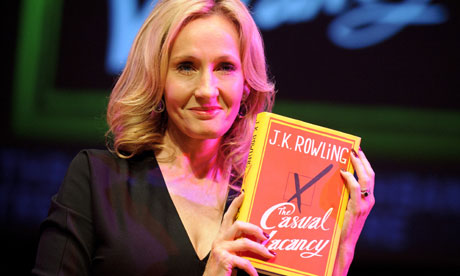
The Casual Vacancy by JK Rowling: A Late Read-Along Post


Alright, a week after I was supposed to, I finished The Casual Vacancy. Am I glad I read it? Yes. Will it be one of my favorite reads this year? No. I liked the end well enough; it was powerful and memorable (albeit a bit contrived), but the rest of the novel was on the slower side. I felt the middle could have been edited down, as there were large sections that dragged. I will say if you have the perseverance to make your way though the middle, I think you'll be happy you did by the end. But the getting there was though for me; whenever I'd put down the book, I wasn't dying to pick it back up. I'm not exactly sure if it was me or the book but regardless, I felt no sense of urgency to finish this. (Clearly, as I missed our last read-along post, and I was hosting.)

Before the book was released, critics joked that an alternate title for the novel could have been Mugglemarch, pointing to it's similarities to George Eliot's Middlemarch, a book I've read twice and respect greatly. The main similarity I noted between The Casual Vacancy and Eliot's classic is that both revolve around a plethora of characters who are all interconnected in a web of dishonesty. That, and both novels lean towards the depressing side of human nature. But that's human nature; it's irrational, selfish, and ignorant. Rowling's novel explores this less than glamorous side of human nature, exposing its weaknesses through a number of imperfect characters. 

He never seemed to grasp the immense mutability of human nature, nor to appreciate that behind every nondescript face lay a wild and unique hinterland like his own.
The last thing I want to do is compare The Casual Vacancy to Harry Potter but what I will say is that if anything, Harry Potter proved that not only does Rowling have an incredible imagination, but she's got a gift for conveying her richly imagined worlds through her writing. In my opinion, there was nothing very imaginative about this novel. Of the ideas she presented, there was nothing new in the way she brought them forth. I did not feel challenged while reading her book (if you don't count my difficulty to finish it) and it all felt a bit mundane. What I will say is Rowling proved she can write adult fiction and she can write it well - her prose is crafted beautifully and her characters are well developed. I'm just hoping that her next novel is more absorbing and a little less trite. 

Publisher: Little, Brown 2012 

Read my initial thoughts on the novel here. I'd also like to thank Beth at Bookworm Meets Bookworm once more for co-hosting the read-along and for designing the lovely button you see above. 

10.11.2012

The Casual Vacancy: A Read-Along Part 2 (Sort Of)


Today we you are posting our final thoughts on The Casual Vacancy. 

So, you guys, I'm just going to come out and say it; I did not finish the book. This is not a DNF because it's horrible, it's a momentary DNF because I have been crunched for time. I am a terrible host and I apologize, because it's a total buzz kill to sign up for a read-along and then have a terrible host. I could get into things like the 3-day wedding festivities I partook in over the weekend and the extra hours I've been putting in at work, but I'll just say I feel like an ass and that's that.

Please feel free to link up your final thoughts below. I will post my final thoughts upon completion and come back to the linkup to read yours. Until then, please accept my apologies and know that I feel terrible.


10.04.2012

The Casual Vacancy: A Read-Along Part 1


Today we are posting our general and early impressions of the novel with NO spoilers. So even if you aren't participating in the read-along, feel free to read on!

It has been one week since The Casual Vacancy was published and I've made it through the first third of the novel. I was a bit overwhelmed with the first few chapters, as we were introduced to a new character on every page, or so it seemed. As I read on things started to come together, only to become a bit stagnant. Yes, so far, I am not head over heels. This isn't to say it's bad; Rowlings writing is fantastic. She can certainly capture a feeling or detail in a way that allows me to imagine it wholly. However, in terms of plot and even character development it feels a little bland. To be fair though, I am only a third of the way through and I have no doubt things will (hopefully) pick up.

From what I've read so far, one device that stands out is Rowling's portrayal of Pagford and its foil, Yarvil. Pagford represents the "English idyll... cupped in a hallow between three hills, one of which was crested with the remains of the twelfth-century abbey. A thin river snaked around the edge of the hill and through town, straddled by a toy stone bridge."  Of course this is in contrast to the long-hated town of Yarvil, filled with unemployed drug addicts who frequent rehab. When social worker Kay Bawden visits a family in Yarvil, she notes the griminess of it all:

Bits of rubbish had tumbled or been scattered over the scrubby patch of lawn, but the bulk of it remained piled beneath one of the two downstairs windows. A bald tire sat in the middle of the lawn... After ringing the doorbell, Kay noticed a used condom glistening in the grass beside her feet, like the gossamer cocoon of some huge grub.
In my opinion, Rowling has succeeded in establishing a detailed and impressive sense of place that encompasses these two contrasting towns - now I'd like to see where this leads. Like I mentioned before, as far as characters go, there are many. I'm starting to get a better sense of what drives each and exactly how varied they all are. Thus far, I'd have to say I really enjoy Andrew. Maybe I have taken a liking because he is an underdog of sorts, or maybe it's because I find his thoughts damn funny. Either way, I look forward to learning what Andrew has got in store for us. It seems as though he may turn out to be a moderator of sorts, in contrast to his hard-headed father.

In addition, I would like to address all the body parts Rowling describes; we have encountered, thus far, balls, penises, breasts, and boners. We read a confession from a virgin who exclaims "Lots of pushing to get in properly. It's tighter than I thought". These descriptions don't feel out of place and I think they add even more color to an already diverse novel. 

All in all, do I love The Casual Vacancy? Not yet, though it may be too soon to tell. What I will say is I'm happy to read something so different from Harry Potter. Regardless of any expectations I had going into this, I was not expecting a story like this. And for that, I'd like to congratulate Rowling.

If you are participating in the read-along, feel free to link up your first post below! We will be posting our final thoughts next Thursday.